Laura Anthony Esq

MAKE VALUED ALLIANCES

Private Investment in Public Equity (PIPE)

Three Paths To A US Listing Prepared by Crocker Coulson, AUM Advisors

THREE PATHS TO A US LISTING

IPO, De-SPAC, or Direct Listing? An Evidence-Based Decision Framework for

Management Teams and Boards of Overseas Companies

Crocker Coulson  |  Founder & CEO,AUM Advisors

September 2026

Sources: Renaissance Capital, SPAC Insider, Jay Ritter (University of Florida), SEC filings, exchange data; AUM Advisors analysis. Market prices are as of 10 September 2026, with quotes for listings completed in 2026 refreshed to 14 September 2026.

3

Distinct paths to a US listing — each suited to a different kind of company

57%

Share of 2025 US IPOs completed by companies headquartered outside the United States

1,100+

Transactions behind the evidence in this guide — every IPO, de-SPAC, and direct listing since 2024, plus 699 de-SPACs since 2010

Who This Guide Is For

This guide is written for the management teams and boards of companies outside the United States that are considering a US listing — and who want a clear, evidence-based Read More »

米国上場への3つの道(AUM Advisors、クロッカー・コールソン作成)

IPO、De-SPAC、それともダイレクト・リスティングか?——海外企業の経営陣・取締役会のためのエビデンスに基づく意思決定フレームワーク
クロッカー・コールソン(Crocker Coulson)  |  AUM Advisors 創業者兼CEO
2026年9月
出所:Renaissance Capital、SPAC Insider、Jay Ritter(フロリダ大学)、SEC提出書類、取引所データ、AUM Advisors分析。株価は2026年9月10日時点(2026年に完了した上場の株価は2026年9月14日時点に更新)。

3
米国上場への3つの異なる経路——それぞれ適した企業のタイプが異なる
57%
2025年の米国IPOのうち、米国外に本社を置く企業が占めた割合
1,100超
本ガイドのエビデンスを支える取引件数——2024年以降のすべてのIPO・De-SPAC・ダイレクト・リスティングに加え、2010年以降の完了済みDe-SPAC 699件

本ガイドの対象読者

本ガイドは、米国上場を検討している米国外企業の経営陣および取締役会に向けて書かれている——売り込みの席に着く前に、米国市場に至る3つの経路について、明確でエビデンスに基づいた理解を得たいと考える方々のためのものである。
米国上場を検討する企業は、引受証券会社からは「伝統的IPOこそがゴールド・スタンダードである」と聞かされるだろう。SPACスポンサーからは「SPAC合併の方が速く、確実である」と聞かされる。また、アドバイザーからは「ダイレクト・リスティングならIPOやDe-SPACに伴う手数料や希薄化を最小化できる」と言われるかもしれない。
これらの主張はいずれも、ある種の企業にとっては正しく、別の企業にとっては高くつく——そして、どれほど有能なアドバイザーであっても、各々は自らが販売する商品について語っているのである。
本ガイドの狙いは異なる。各経路がどのように機能するのか、それぞれ何を要するのか、何をもたらすのか、そして——2024年以降のすべての米国上場の完全な記録を用いて——各々の扉を選んだ企業に実際に何が起きたのかを解説することにある。
米国の資本市場は、依然として世界で最も厚みがあり、流動性が高く、柔軟性に富む市場であり、適格な国際企業に対して引き続き開かれている。2025年の米国IPOの57%は海外に本社を置く企業によるものであり、2026年上半期に発表されたSPAC合併の対象企業の43%は国際企業である。機会は現実のものである。同時に、米国市場に至るそれぞれの扉の違いもまた現実である。
エビデンスについての注記。本ガイドの定量的な記述はすべて、明示された情報源に基づいている。Renaissance CapitalのIPOデータセット、SPAC InsiderのDe-SPACユニバース、Jay Ritter教授の学術データ、SEC提出書類、取引所の取引記録に加え、当社が公表してきた調査研究——『The Five Disciplines of De-SPAC Success』(2010年以降の完了済みDe-SPAC 699件)、『The De-SPAC Scorecard』(四半期刊行)、『Everything Is Negotiable』(2026年上半期のすべての合併契約を分析)——を用いている。当社の目的は、脚色のないデータと、各企業が自らの選択肢を検討するためのフレームワークを提供することにある。

企業はなぜ米国上場を目指すのか——3つの目的

株式公開の意思決定は、突き詰めれば、次の3つの何らかの組み合わせを「購入」する行為である。

  1. 資金調達(プライマリー・キャピタル)——成長資金としてバランスシートに入る新たな資本。
  2. 流動性——創業者・従業員・初期投資家が保有株式を時間をかけて現金化でき、新たな投資家がポジションを構築できる取引市場。
  3. 信認とレピュテーション——継続的に形成される公開株価、世界的に認知された取引所への上場、そしてそれに伴う顧客・取引先・金融機関・買収候補先・将来の投資家からの信頼。

この3つの目的こそ、本ガイドがすべての経路を測定する物差しである。世間の論評の大半は——率直に言えば、当社を含む調査研究の大半も——最も測定しやすい株価だけを測ってきた。
株価は重要であり、本ガイドでも取引データのエビデンスを提示する。しかし、株価が高くとも実質的な売買高が育たない上場は、流動性を提供できていない。アナリスト・カバレッジのない上場は、信認を提供できていない。そして、追加増資(フォローオン)を実行できない上場は、持続的な資本アクセスを提供できていない。
そこで本ガイドは、並べて示されることの稀な2つの指標——取引流動性とアナリスト・カバレッジ——を、各経路の直近の上場企業群について追加的に測定する。
米国資本市場のもう一つの優位性を冒頭で強調しておきたい。各経路のコストをどう評価すべきかを左右するからである。それは、米国市場が持つ極めて柔軟な追加資金調達(フォローオン・ファイナンス)の仕組みである。
上場して一定期間が経過した米国上場企業は、一括登録(シェルフ・レジストレーション)、ATMプログラム(市場売却型増資)、レジスタード・ダイレクト、転換社債といった手段を通じて、多くの場合わずか数日で、低コストに、ロードショーの有無を問わず追加資本を調達できる。最初の上場は最後の資金調達ではない。多くの成長企業にとって、それは数多くの調達の最初の一回にすぎない。2回目・3回目の調達に向けて企業を有利に位置づける経路であれば、投資家による「最初の一口」に相応の価格譲歩を与える価値は十分にある。

3つの上場経路の概要

成果を比較する前に、各プロセスで実際に何が起きるのかを正確に押さえておくことが有益である。平易に述べれば、以下のとおりである。

伝統的IPO——新株のマーケティングを伴う売出し

企業はSECに登録届出書(Form S-1、外国民間発行体の場合はF-1)を提出し、投資銀行を引受会社(アンダーライター)として起用する。SECの審査を経て、経営陣はロードショー——通常1〜2週間にわたる機関投資家との面談——を行い、その間に引受会社は「ブックビルディング」、すなわち提示価格帯での注文集約を進める。取引開始前夜、企業と引受会社が公開価格を決定する。引受会社は株式を自ら買い取ったうえで、選定した投資家に転売する。自己資本と目論見書に対する法的責任をもってディールを支えるのである。取引初日には、引受会社はオーバーアロットメント(「グリーンシュー」)による追加株式を用いて株価を支えることができる。企業は、引受手数料(中小型案件でおおむね5〜7%)を差し引いた調達資金を受け取る。

SPAC合併(De-SPAC)——上場シェル企業との交渉による合併

特別買収目的会社(SPAC)は、既に株式公開を済ませたシェル(器)企業であり、IPOで調達した資金を信託口座に(伝統的には1株当たり10.00ドルで)保管しながら、合併相手となる事業会社を探す。対象企業はSPACのスポンサーとの間で企業結合契約(BCA)を交渉し、対象企業の評価額を契約によって確定させる。その後、当事者は通常、機関投資家からPIPE(上場企業私募増資)を調達し、信託資金を補完——実務上はしばしば代替——する。SPACの株主は、合併後の会社に投資を続けるのではなく、株式を現金で償還する権利を保持しているためである。SECの審査を経た委任状勧誘書類または登録届出書と株主総会の承認を経て合併が完了すると、対象企業はSPACの取引所上場を承継して上場企業となる。スポンサーの報酬は「プロモート」株式——伝統的にはシェル企業の株式の20%——であり、加えてSPACのワラントおよびライツも残存する。

ダイレクト・リスティング(直接上場)——募集を伴わない取引市場の開設

ダイレクト・リスティングでは、企業は既存株主の保有株式を転売目的で登録し、そのまま取引を開始する——新株の売出しはなく、資金調達もなく、引受会社によるブックビルディングもなく、株価を支える義務を負う者も存在しない。取引所は基準価格を設定し(私設市場での取引実績があればそれに基づき、なければ企業自身が委託する独立第三者による価値評価に基づく)、売り手と買い手が出会う寄付きオークションによって株式の取引が始まる。既存株主は原則として取引開始の瞬間から売却できる。アドバイザーは定額報酬でプロセスを支援するが、引受は行わない。寄付きオークションでの資金調達を認める変型は2020〜2021年から可能となっているが、ほとんど利用されていない。
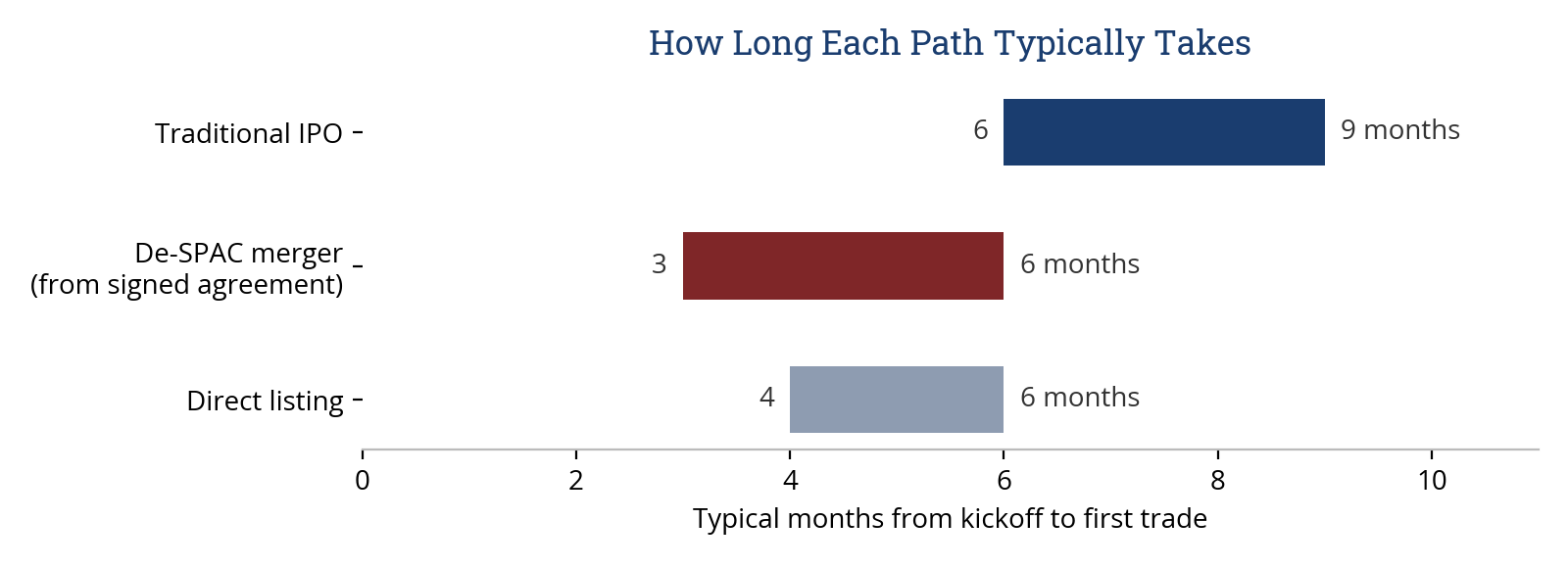
図1. プロセス開始から初値形成までの標準的な所要期間。De-SPACの期間は合併契約締結時点を起点とし、対象企業がPCAOB基準の監査を整備済みであることを前提とする。契約締結前の相手探索・交渉期間は案件により大きく異なる。出所:AUM Advisors。

伝統的IPO SPAC合併(De-SPAC) ダイレクト・リスティング
売却されるもの 新株(引受会社が選定した投資家へ) PIPE投資家への新株。信託資金は残存または償還 なし——既存株式が取引可能になる
価格の決定者 投資家の注文に基づき引受会社と企業 企業とスポンサーの交渉 寄付きオークション
資金調達 あり——主目的 あり——PIPEに加え、残存する信託資金 原則なし
アフターマーケットの支え手 引受会社(グリーンシュー)、その後はリサーチ 株価安定化措置なし。PIPEのロックアップが下支え 存在しない
主な手数料 引受手数料5〜7%+直接費用2〜4% スポンサーのプロモート+助言・私募手数料+SPAC IPO時の繰延手数料 定額の助言報酬+直接費用1〜2%
初値までの標準期間 6〜9カ月 契約締結から3〜6カ月 4〜6カ月
インサイダーのロックアップ 約180日が標準 交渉による。優良案件ではインサイダーとPIPEに12〜18カ月 ないことが多い

表1. 3つの経路の仕組みの比較。出所:AUM Advisors。

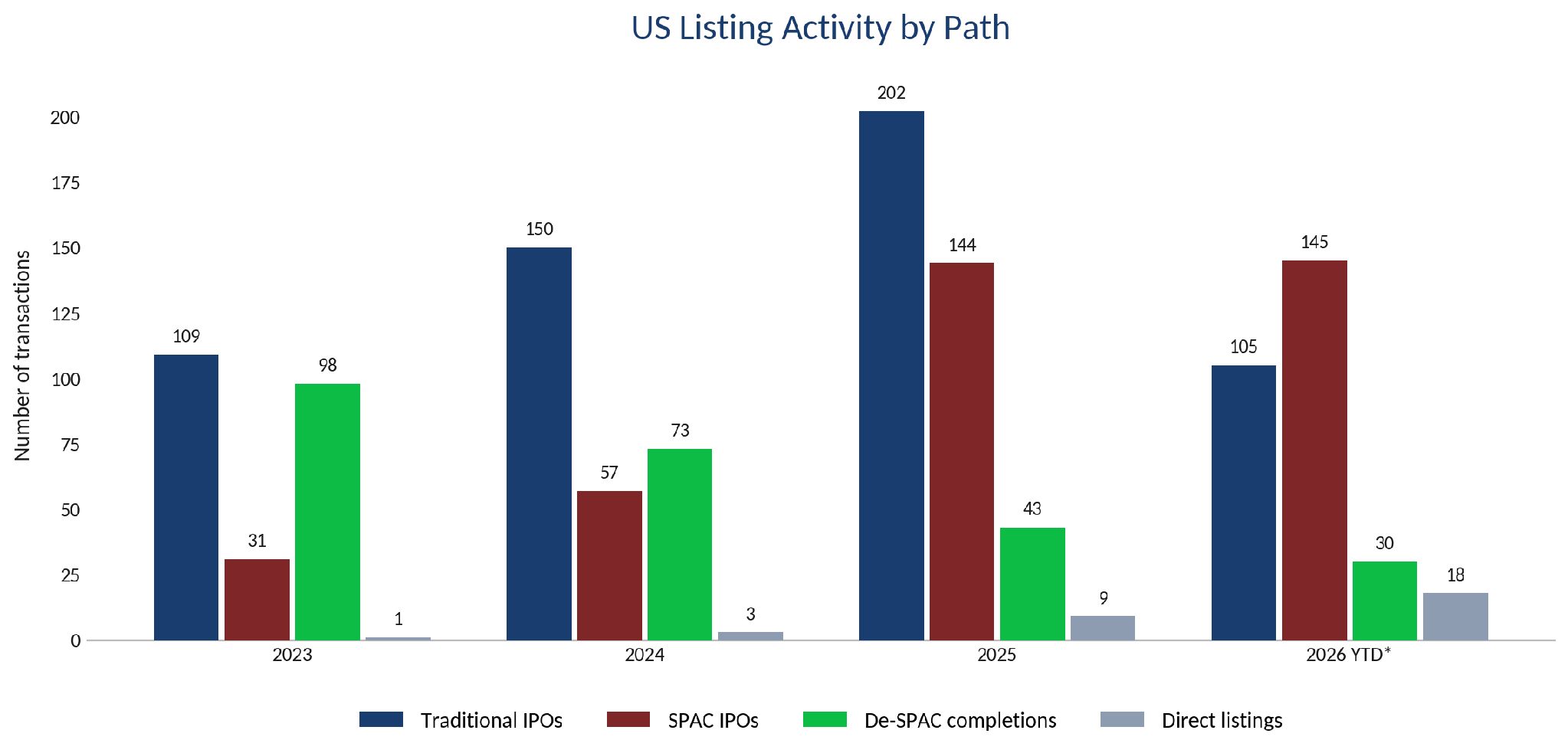
図2. 経路別の米国上場件数(2023年〜2026年*は2026年8月27日まで)。伝統的IPO件数はRenaissance Capital(時価総額5,000万ドル以上、SPAC除く)。SPAC IPOおよびDe-SPAC完了件数はSPAC Insider(2023年のSPAC IPO件数はRenaissance Capital)。ダイレクト・リスティングはJay Ritter教授のTable 13a(2026年8月27日更新)。出所:Renaissance Capital、SPAC Insider、AUM Advisors分析。

各経路がもたらす成果の測定

企業が株式を公開する理由は3つあるのだから、当社は各経路の直近の上場企業群について、株価がどう推移したか、取引市場がどれだけの流動性を獲得したか、そして各群がどれだけのアナリスト・カバレッジを獲得したか——カバレッジは流動性と信認の双方を支える——を測定する。株価の実績は、後続の各経路の章を通じて提示する。
流動性指標についての注記:以下の図表は、2026年9月10日までの直近20営業日平均の売買代金(ドルベース)を用いており、当初想定していた「上場後最初の90営業日」および「直近90営業日」という2つの測定期間は用いていない。したがって図表が示すのは各群の現在の姿であって、その変化の過程ではない。上場後の数カ月間に流動性がどのように変化するかについて、本ガイドはここでは何ら主張しない。
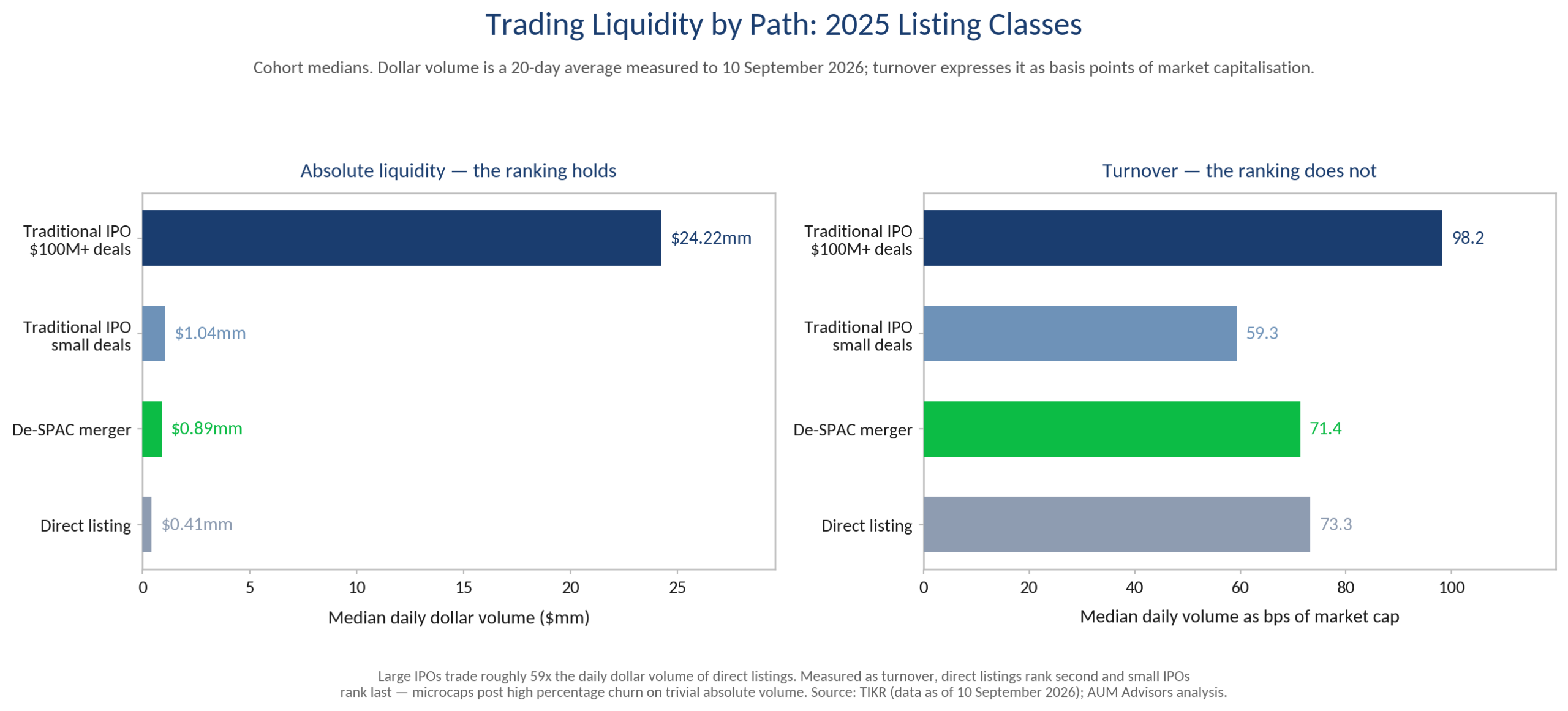
図3. 経路別の取引流動性(2025年上場企業群)。4群の中央値:1億ドル以上の伝統的IPO(n=67)、小型IPO(n=48)、完了済みDe-SPAC(n=37)、ダイレクト・リスティング(n=8)。左パネルは1日当たり売買代金の中央値、右パネルは同じ売買代金を時価総額に対するベーシスポイントで表示。売買代金は2026年9月10日までの20営業日平均。少数の大型銘柄が典型的な姿を覆い隠すことを避けるため、平均値ではなく中央値を用いる。出所:TIKR、AUM Advisors分析。
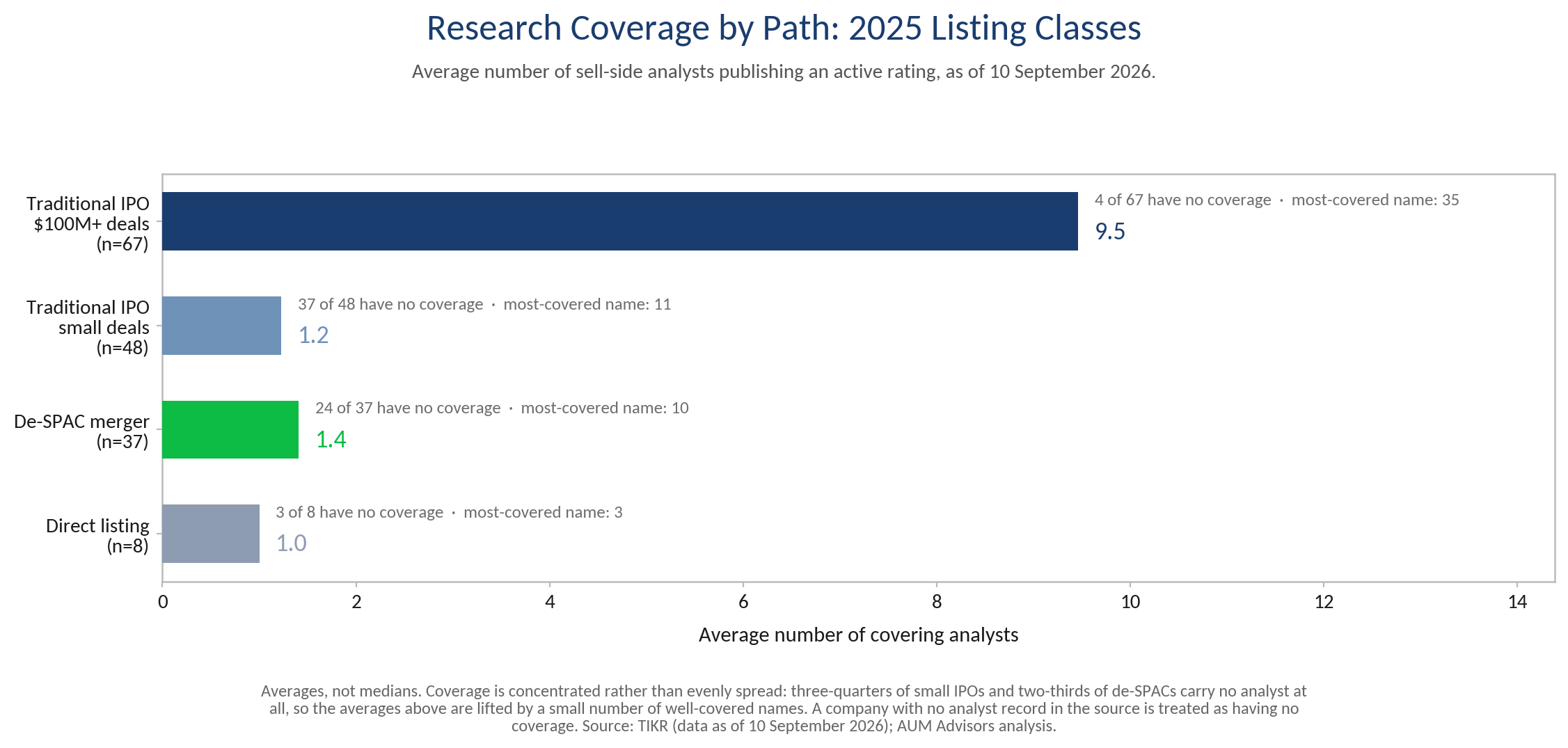
図4. 経路別のアナリスト・カバレッジ(2025年上場企業群)。同じ4群について、レーティングを公表するセルサイド・アナリスト数の平均値を示し、カバレッジが全くない企業の数を各バーに併記。カバレッジは均等に分布するのではなく一部の銘柄に集中しており、平均値は少数の手厚くカバーされた銘柄によって押し上げられている。アナリスト記録のない企業はカバレッジなしとして扱う。カバレッジは機関投資家からの認知度を測る最も明確な代理指標であり、持続的な流動性の先行指標である。出所:TIKR、AUM Advisors分析。

データが示すもの

これらの指標において、大型IPOは大差で首位に立つ。

  • 1日当たり売買代金の中央値は2,422万ドル。小型IPOの104万ドル、De-SPACの89万ドル、ダイレクト・リスティングの41万ドルを大きく上回る。
  • カバレッジ・アナリスト数は平均9.5名。対して小型IPOは1.2名、De-SPACは1.4名、ダイレクト・リスティングは1.0名である。

ただし、絶対額ではなく時価総額に対する売買回転率で測ると、ダイレクト・リスティングは1日当たり73.3ベーシスポイントで第2位となり、De-SPACの71.4、小型IPOの59.3を上回る。この第2位という順位は慎重に読む必要がある。既に崩落した時価総額を分母とする回転率は、流動性ではなく回転売買(チャーン)を映すものである——ドルベースでは、ダイレクト・リスティングの中央値の売買代金はDe-SPACの中央値の半分にも満たない。
なお、小型IPOとDe-SPACはこれらの指標においてほとんど区別がつかない——1日当たり売買代金は104万ドル対89万ドル、カバレッジ・アナリスト数の平均はそれぞれ1.2名対1.4名であり、小型IPOの77%、De-SPACの65%はリサーチ・カバレッジを全く持たない。ここから導かれる要点は次のとおりである。第一に、SPAC合併・小型IPO・ダイレクト・リスティングのいずれも、大半の機関投資家が求める流動性の水準に達するには通常時間を要する。このため、これらの経路を選ぶ企業は上場後の投資家向けマーケティングに一層の時間とエネルギーを投じる必要があり、広く投資可能な銘柄へと「クロスオーバー」するために追加増資(フォローオン)が必要となる場合が多い。第二に、これら3つの経路のいずれで上場する企業も、上場後1年間はリサーチ・カバレッジの獲得に投資する必要がある。リサーチおよび投資銀行の双方との関係を育て、リサーチと資本市場活動を連動させ、場合によっては特定の証券会社とのCMA(キャピタル・マーケッツ・アドバイザリー)契約を検討することも含まれる。

経路I:伝統的IPO

伝統的IPOが標準的な選択肢であり続けるのには理由がある。資金調達・流動性・信認という3つの目的すべてを一度のイベントで実現できる唯一の経路であり、他の経路であれば上場後に(そもそも構築できればの話だが)構築しなければならないインフラを、最初から備えて市場に到着できるからである。

適切に執行されたIPOがもたらすもの

  • 初日からの幅広い機関投資家株主基盤。ブックビルディングの過程で、株式は引受会社が選定した数十の機関投資家——ロングオンリー・ファンド、セクター・スペシャリスト、インデックス関連の買い手——に直接配分される。彼らは経営陣と面談し、事業内容を検討したうえで、保有を選択した投資家である。他の経路では、この株主基盤を上場後1〜2年かけて、面談を一つひとつ積み重ねて獲得しなければならない。
  • 速やかなリサーチ・カバレッジ。引受銀行は通常、IPO後のクワイエット・ピリオド明けにセルサイド・カバレッジを開始する——有力な引受会社による中規模案件であれば、数週間のうちに3〜5名のアナリストが付くことが多い。カバレッジは機関投資家からの認知、バリュエーションの文脈、売買高を牽引する。他の経路で上場した企業は、カバレッジ関係を築くまでの6〜18カ月間、リサーチ空白(リサーチ・デザート)に直面するのが通例である。
  • 上場1年目からの活発な取引。幅広い初期配分、リサーチ、インデックス採用適格性が組み合わさり、相応の規模のIPOでは3経路の中で最も健全な初期取引が実現する。
  • スタート時点でのアフターマーケット支援。グリーンシューにより、引受会社は初期の取引を安定化させる手段とインセンティブの双方を持つ——他の2経路には存在しない緩衝装置である。
  • レピュテーション・プレミアム。公正か否かは別として、「当社はNYSE/Nasdaqで IPOを完了した」という一文は、顧客・取引先・金融機関・買収候補先に対して、他のどのような表現よりも重みを持つ。エンタープライズ営業、規制産業、M&Aプログラムなど、事業戦略が信用力に依存する企業にとって、これは曖昧な便益ではない。受注率や取引条件に表れるのである。

初日株価上昇(ポップ)の理解——コスト、シグナル、戦略

IPOで最も議論される特徴は、初日の株価急騰である。初日リターンの長期平均はおよそ18%(Ritter、1980〜2025年)。2025年は米国IPO全体で19.7%、1億ドル超の案件群では約25%であった。
一つの読み方をすれば、ポップは調達資金に対する暗黙のディスカウントである。企業ではなく、配分を受けた投資家に渡った追加的な価値を意味する。この読み方は正しい。3億ドルの調達で20%のポップが生じれば、およそ6,000万ドルの価格譲歩となり、引受手数料そのものの数倍に相当する。
しかし、ポップにはより繊細な読み方も必要である。
初日の株価上昇は、ある意味で、マーケティングの成功を可視化したものである。需要が供給を大きく上回った結果、投資家は希望したポジションの一部しか配分を受けられず——その後の数週間、市場で買い増しを続けた。この未充足の需要は無駄にはならない。それはアフターマーケットの買い需要となり、追加増資の際の注文となり、最初の数四半期の決算を通じて株価を支える株主基盤となる。
複数回の資金調達を計画する企業は(そして米国市場のシェルフ・レジストレーション、ATMプログラム、転換社債市場を踏まえれば、大半の成長企業はそれを計画すべきである)、2回目・3回目の調達を安価かつ迅速にする投資家基盤を確保するために、最初の調達で価格譲歩を受け入れることに合理性がある。IPOは、可能な限り高い価格で執行する一回きりの売却としてではなく、公開市場との長期的な資金調達関係の最初の取引として理解するのが最も適切である。
したがって実務上の指針は、「ポップを避けよ」ではなく「譲歩が何かを買っていることを確かめよ」である。質の高い機関投資家のブック、速やかなリサーチ・カバレッジ、活発な取引を伴う15〜25%のポップは、有効に使われた譲歩である。見栄えのために「ポップするよう」値付けされ、初日に転売する短期筋に配分されたディールは、何も買っていない。その差は、ほぼすべて引受会社の選定と配分の規律にかかっている——発行体のアドバイザーが真価を発揮すべき領域である。

IPOが適切な選択となる場合

IPOが適するのは、有力な引受会社の関心と注力を引きつけられる企業——現実的には5,000万〜1億ドル以上の募集規模——であり、機関投資家がモデル化できる財務プロファイルを持ち、2週間のマーケティング期間で伝わるストーリーを持つ企業である。
レピュテーション・プレミアムを重視し、複数回の資金調達を計画し、価格決定日の市場リスクを許容できる企業に適している。一方で、規模の閾値に満たない企業、説明に数週間ではなく数カ月を要するストーリー、そして長年待機してきた超大型案件がIPOカレンダーに詰まり、引受会社と投資家の関心を吸い上げている局面には適さない——これは2025〜2026年に実際に起きた現象であり、数年越しの遅延を経て史上有数の大型案件が相次いで市場に到来した。 Read More »


Who Is An Affiliate And Why Does It Matter – Primary VS Secondary Offering

The concept of affiliation resonates throughout the federal securities laws, including pertaining to both the Securities Act and Exchange Act rules, regulations and forms and Nasdaq and NYSE compliance.  In this multipart series of blogs, I will unpack what the term “affiliate” means and its implications.  This first blog in the series began with an analysis of the Securities Act definition of “affiliate” and the implications under Rule 144, Section 4(a)(7) and Form S-3 eligibility (see HERE).  In this Part 2 of the series, I am delving into the meaty topic of a primary vs. secondary offering, which itself hinges on whether the offeror is an affiliate.

Secondary/Resale Offerings vs. Primary Offerings

A secondary offering is an offering made by or on behalf of bona fide selling shareholders and not by or on behalf of the registrant company.  A secondary offering can only occur after a company is public.  That is, even if a company goes public Read More »

SEC Proposes New SPAC Rules – Part 2

On March 30, 2022, the SEC proposed rules enhancing disclosure requirements associated with SPAC initial public offerings (IPOs) and de-SPAC merger transactions; requiring that a private operating company be a co-registrant when a SPAC files an S-4 or F-4 registration statement associated with a business combination; requiring a re-determination of smaller reporting company status within four days following the consummation of a de-SPAC transaction; amending the definition of a “blank check company” to make the liability safe harbor in the Private Securities Litigation Reform Act of 1995 for forward-looking statement such as projections, unavailable in filings by SPACs and other blank check companies; and deeming underwriters in a SPAC IPO to be underwriters in a de-SPAC transaction when certain conditions are met.

The proposed rules would require specialized disclosure with respect to compensation paid to sponsors, conflicts of interest, dilution and the fairness of business combination transactions.  Further disclosures will also be required in connection with the use of projections.  Read More »

SEC Proposes New SPAC Rules – Part 1

As I wrote about last week, the SEC has had a very busy rule-making few weeks.  In addition to issuing six new compliance and disclosure interpretations (C&DI) for merger and acquisition transactions, most of which directly impact SPAC business organization transactions, it also proposed new rules on SPACs and all shell companies in a 372-page release. The new C&DI were the topic of last week’s blog (HERE) and in a multi-part blog series, I am delving into the proposed new SPAC rules.

On March 30, 2022, the SEC proposed rules enhancing disclosure requirements associated with SPAC initial public offerings (IPOs) and de-SPAC merger transactions; requiring that a private operating company be a co-registrant when a SPAC files an S-4 or F-4 registration statement associated with a business combination; requiring a re-determination of smaller reporting company status within four days following the consummation of a de-SPAC transaction; amending the definition of a “blank check company” to make the Read More »

Regulation By Enforcement

The SEC is well known for, and often criticized for, its practice of regulation by enforcement.  In recent years the SEC has been more willing to regulate by enforcement, propounding novel and new interpretations to longstanding rules and regulations.  Market participants have taken notice, and offense.  Advocacy groups have been very vocal against the practice including the Financial Services Institute and Small Public Company Coalition (SPCC).

Although not limited to matters involving cryptocurrencies, blockchain and all things Web3, is the area that garners the most attention for the SEC’s enforcement-based guidance, probably because it is undeniably the topic that is in the most need of actual rule-based regulation.  Starting with the SEC’s 2017 Section 21(a) Report stemming from the enforcement action against the DAO, Slock.it (see HERE), almost all substantive regulatory prescription related to the world of crypto has come from enforcement actions.

Rather than heed the calls for rules and regulations over the years, the SEC has Read More »

SEC Proposes Amendments To Rule 144

I’ve been at this for a long time and although some things do not change, the securities industry has been a roller coaster of change from rule amendments to guidance, to interpretation, and nuances big and small that can have tidal wave effects for market participants.  On December 22, 2020, the SEC proposed amendments to Rule 144 which would eliminate tacking of a holding period upon the conversion or exchange of a market adjustable security that is not traded on a national securities exchange.  The proposed rule also updates the Form 144 filing requirements to mandate electronic filings, eliminate the requirement to file a Form 144 with respect to sales of securities issued by companies that are not subject to Exchange Act reporting, and amend the Form 144 filing deadline to coincide with the Form 4 filing deadline.

The last amendments to Rule 144 were in 2008 reducing the holding periods to six months for reporting issuers and one year Read More »

SPAC IPOs A Sign Of Impending M&A Opportunities

The last time I wrote about special purpose acquisition companies (SPACs) in July 2018, I noted that SPACs had been growing in popularity, raising more money in 2017 than in any year since the last financial crisis (see HERE).  Not only has the trend continued, but the Covid-19 crisis, while temporarily dampening other aspects of the IPO market, has caused a definite uptick in the SPAC IPO world.

In April, the Wall Street Journal (WSJ) reported that SPACs are booming and that “[S]o far this year, these special-purpose acquisition companies, or SPACs, have raised $6.5 billion, on pace for their biggest year ever, according to Dealogic. In April, 80% of all money raised for U.S. initial public offerings went to blank-check firms, compared with an average of 9% over the past decade.”

I’m not surprised.  Within weeks of Covid-19 reaching a global crisis and causing a shutdown of the U.S. economy, instead of my phone Read More »

Disclosures Related To COVID-19

The SEC has been reiterating the need for robust disclosures related to the impact of COVID-19 on publicly reporting companies.  In the last few weeks I have written about some of the guidance issued by the SEC including Disclosure Guidance Topic No. 9.  Since that time the SEC has continued to issue guidance in the form of public statements.  This blog will summarize the SEC guidance and statements on disclosures up to date, and include a sample risk factor for inclusion in SEC reports.

Public Statement by Chair Jay Clayton and Director of the Division of Corporation Finance, William Hinman

On April 8, 2020, SEC Chairman Jay Clayton and William Hinman, the Director of the Division of Corporation Finance, issued a joint public statement on the importance of disclosure during the COVID-19 crisis.

Before I get into summarizing the statement, my personal thought is that although there are many reasons why disclosure is important, including the basic premise that the Read More »

The 20% Rule – Private Placements

Nasdaq and the NYSE American both have rules requiring listed companies to receive shareholder approval prior to issuing twenty percent (20%) or more of the outstanding securities in a transaction other than a public offering at a price less than the Minimum Price, as defined in the rule. Nasdaq Rule 5635 sets forth the circumstances under which shareholder approval is required prior to an issuance of securities in connection with: (i) the acquisition of the stock or assets of another company (see HERE); (ii) equity-based compensation of officers, directors, employees or consultants (see HERE); (iii) a change of control (see HERE); and (iv) transactions other than public offerings. NYSE American Company Guide Sections 711, 712 a 713 have substantially similar provisions.

Nasdaq and the NYSE recently amended their rules related to issuances in a private placement to provide greater flexibility and certainty for companies to determine when a shareholder vote is necessary to approve a transaction that Read More »

SEC Cracks Down On Failure To File 8-K For Financing Activities; An Overview Of Form 8-K

Introduction and Background

On September 26, 2016, and again on the 27th, the SEC brought enforcement actions against issuers for the failure to file 8-K’s associated with corporate finance transactions and in particular PIPE transactions involving the issuance of convertible debt, preferred equity, warrants and similar instruments. Prior to the release of these two actions, I have been hearing rumors in the industry that the SEC has issued “hundreds” of subpoenas (likely an exaggeration) to issuers related to PIPE transactions and in particular to determine 8-K filing deficiencies. Using this as a backdrop, this blog will also address Form 8-K filing requirements in general.

Back in August 2014, the SEC did a similar sweep related to 8-K filing failures associated with 3(a)(10) transactions. See my blog HERE for a discussion of those actions and 3(a)(10) proceedings in general. The 8-K filing deficiency actions were a precursor to a larger SEC investigation on 3(a)(10) transactions themselves which culminated in two well-known Read More »

SEC Study On Unregistered Offerings

In October 2015, the SEC Division of Economic and Risk Analysis issued a white paper study on unregistered securities offerings from 2009 through 2014 (the “Report”). The Report provides insight into what is working in the private placement market and has been on my radar as a blog since its release, but with so many pressing, timely topics to write about, I am only now getting to this one. The SEC Report is only through 2014; however, at the end of this blog, I have provided supplemental information from another source related to PIPE (private placements into public equity) transactions in 2015.

Private offerings are the largest segment of capital formation in the U.S. markets. In 2014 private offerings raised more than $2 trillion. The SEC study used information collected from Form D filings to provide insight into the offering characteristics, including types of issuers, investors and financial intermediaries that participate in offerings. The Report focuses on Regulation D offerings Read More »

SEC Has Approved A Two-Year Tick Size Pilot Program For Smaller Public Companies

On May 6, 2015 the SEC approved a two-year pilot program with FINRA and the national securities exchanges that will widen the minimum quoting and trading increments, commonly referred to as tick sizes, for the stocks of smaller public companies.  The goal of the program is to study whether wider tick sizes improve the market quality and trading of these stocks. 

The basic premise is that if a tick size is wider, the spread will be bigger, and thus market makers and underwriters will have the ability to earn a larger profit on trading.  If market makers and underwriters can earn larger profits on trading, they will have incentive to make markets, support liquidity and issue research on smaller public companies.  The other side of the coin is that larger spreads and more profit for the traders equates to increased costs to the investors whose accounts are being traded. 

The tick size program includes companies that meet the following $3 Read More »

Direct Public Offering or Reverse Merger; Know Your Best Option for Going Public

Introduction

For at least the last twelve months, I have received calls daily from companies wanting to go public.  This interest in going public transactions signifies a big change from the few years prior.

Beginning in 2009, the small-cap and reverse merger, initial public offering (IPO) and direct public offering (DPO) markets diminished greatly.  I can identify at least seven main reasons for the downfall of the going public transactions.  Briefly, those reasons are:  (1) the general state of the economy, plainly stated, was not good; (2) backlash from a series of fraud allegations, SEC enforcement actions, and trading suspensions of Chinese companies following reverse mergers; (3) the 2008 Rule 144 amendments including the prohibition of use of the rule for shell company and former shell company shareholders; (4) problems clearing penny stock with broker dealers and FINRA’s enforcement of broker-dealer and clearing house due diligence requirements related to penny stocks; (5) DTC scrutiny and difficulty in obtaining clearance following Read More »

SEC Updates May Benefit Equity Line Financing Providers and Issuers

On May 16, 2013, the SEC updated their Compliance and Disclosure Interpretations addressing the point at which an equity line agreement can be determined to be a completed transaction for purposes of filing a resale registration statement. 

Background

Equity line financings are transactions where a company has a long-term contract to put shares to an investor (the equity line provider) at a price, generally determined by a formula based on a discount to market price.  That is, the Issuer has the right to tell the investor when to buy securities from the Issuer over a set period of time and the investor has no right to decline to purchase the securities (or a limited right to decline).  Generally, the dollar value of the Read More »

The OTCQX And OTCQB Are Finally Recognized As “Established Public Markets” By The SEC

Back in October 2010 I wrote a blog titled “Has the OTCBB been replaced by the OTCQX and OTCQB”; at the time and up until May 16, 2013, my opinion was “yes” with one big caveat.  Prior to May 16, 2013, all three tiers of the OTC Link were considered “pinksheets” by the SEC staff.  Prior to May 16, 2013, the OTC Link was not considered a market and therefore: (1) there could be no at-the-market pricing of securities registered for resale by an Issuer on behalf of its selling shareholders; and (2) there could be no equity lines or similar financing transactions and no registration of underlying convertible equities which are priced based on a formula tied to the trading price (usually a discount to market), for OTC Link quoted securities.

On May 16, 2013, the SEC updated their Compliance and Disclosure Interpretations confirming that the OTCQB and OTCQX marketplaces are now considered public marketplaces for purposes of establishing Read More »

Q2 By The Numbers – An Analysis of Market

First, I’d like to give credit to The DealFlow Report which was my initial source for the numerical factual information in this blog.


The Numbers and Facts

Q2 reflects the uncertainty that goes along with an election year and the concerns over tax increases (or decreases) that go along with election years.  There also remains the ongoing worry over European markets.  In short, it is a time of change and uncertainty.  Moreover, according to Adam Lyon, a managing director and co-head of private capital at Conaccord Genuity, the small cap financing market, “is probably in for the usual seasonal fluctuations: a tough summer followed by a pick-up in late August and September.”  I note that my law firm has seen this trend consistently for the past decade.

According to data from Dealogic, the number of IPO’s dropped by 41.4% in Q2, however, mainly as a result of the facebook IPO, the dollar value of those IPO’s rose by 56.4%.  Read More »

Convertible Promissory Notes; Flexible Financing Options

I have explored the topic of promissory notes in previous articles. This analysis shall specifically concentrate on convertible promissory notes.

As a reminder, a promissory note is a written promise by a person, persons or entity to pay a specific amount of money (called “principal”) to another, usually to include a specified amount of interest on the unpaid principal amount.  In addition, a promissory note will include the basic specifics of the debt, including the debtor and creditor, when payment or payments are due, interest rates, if the debt is secured, and whether the debt may be converted into stock or other equity.  A promissory note that may be converted is often referred to as either a debenture or a convertible promissory note.

Notes Can Be Sold or Assigned

Unless specifically prohibited in the language of the note, a promissory note is assignable by the lender.  That is, the lender can sell or assign the note to a third party Read More »

PIPE Transactions, Terms and Requirements

A PIPE (Private Investment in Public Equity) transaction is typically a private placement of equity or equity-linked securities by a public company to accredited investors that is followed by the registration of the resale of those securities with the SEC. Generally the securities are sold at a discount to market price. A traditional PIPE generally involves a fixed number of securities at a fixed price, with the closing conditioned only on the effectiveness of a resale registration statement. Any transaction that does not fall within this parameter is considered non-traditional and the structure can vary widely, including for example price variables (such as a death spiral), warrants and options, convertible securities and equity line transactions.

Traditional PIPE Transactions

In particular, a traditional PIPE is generally a set number of securities at a set price (which may be a discount to market at the time of close) and is conditioned only upon the effectiveness of a re-sale registration statement. A traditional Read More »

Equity Line Financing Examined

In a typical “equity line” financing arrangement, an investor and an Issuer enter into a written agreement whereby the Issuer has the right to “put” its securities to the investor. That is, the Issuer has the right to tell the investor when to buy securities from the Issuer over a set period of time and the investor has no right to decline to purchase the securities (or a limited right to decline). Generally the dollar value of the equity line is set in the written agreement, but the number of securities varies based on a formula tied to the market price of the securities at the time of each “put”.

Similar to PIPE Transactions

Most equity line financing arrangements are similar to a PIPE (private investment into public entity) transaction such that the Issuer relies on the private placement exemption from registration to sell the securities under the equity line and then files a registration statement for the re-sale of Read More »

When Can Separate Issuer Offerings That Occur Within a Short Time Be Integrated?

The integration doctrine prevents issuers from circumventing the registration requirements of the Securities Act of 1934 by determining whether two or more securities offerings are really one offering that does not qualify as an exempt offering, or an exempt offering is really part of a registered public offering.

Securities Act Release No. 33-4552 (November 6, 1962) sets forth a five factor test that is used as a guideline in determining whether the separate offerings of an issuer that occur within a short time of one another will be integrated. These same factors are set forth in the Note to Rule 502(a) of Regulation D, which factors address whether the offerings:

  1. are part of a single plan of financing;
  2. involve the issuance of the same class of securities (convertible securities, warrants, and other
  3. derivative instruments generally are deemed to be the same class as the underlying security unless the terms of the primary security prohibit exercises until at least the one
Read More »

The Demise of the Death Spiral – SEC Interpretation of Rule 415

Without fanfare, publications, or other notice, in mid 2006, PIPE investors and the Issuers that utilized them noticed a big difference in the way that the Securities and Exchange Commission’s (SEC) division of corporate finance reviewed and commented upon, resale registration statements. Although the SEC staff contended that its position on Rule 415 had not changed, there was, incontrovertibly, a dramatic impact felt by Issuers and PIPE investors.

For years, Issuers had relied upon Rule 415 in order to register the resale of shares issued in PIPE transactions (a “secondary offering”). Rule 415 governs the registration requirements for the sale of securities to be offered on a delayed or continuous basis, such as in the case of the take down or conversion of convertible debt and warrants. In the years prior to 2006, Issuers would register shares they sold in a PIPE transaction, which could represent in excess of 50% of their outstanding public float.

Convertible Debt and Subsequent Resale Read More »

Categories

Contact Author

Laura Anthony Esq

Have a Question for Laura Anthony?