
Laura Anthony Esq

MAKE VALUED ALLIANCES

SPAC Rules

米国上場への3つの道(AUM Advisors、クロッカー・コールソン作成)

IPO、De-SPAC、それともダイレクト・リスティングか?——海外企業の経営陣・取締役会のためのエビデンスに基づく意思決定フレームワーク
クロッカー・コールソン(Crocker Coulson)  |  AUM Advisors 創業者兼CEO
2026年9月
出所:Renaissance Capital、SPAC Insider、Jay Ritter(フロリダ大学)、SEC提出書類、取引所データ、AUM Advisors分析。株価は2026年9月10日時点(2026年に完了した上場の株価は2026年9月14日時点に更新)。

3
米国上場への3つの異なる経路——それぞれ適した企業のタイプが異なる
57%
2025年の米国IPOのうち、米国外に本社を置く企業が占めた割合
1,100超
本ガイドのエビデンスを支える取引件数——2024年以降のすべてのIPO・De-SPAC・ダイレクト・リスティングに加え、2010年以降の完了済みDe-SPAC 699件

本ガイドの対象読者

本ガイドは、米国上場を検討している米国外企業の経営陣および取締役会に向けて書かれている——売り込みの席に着く前に、米国市場に至る3つの経路について、明確でエビデンスに基づいた理解を得たいと考える方々のためのものである。
米国上場を検討する企業は、引受証券会社からは「伝統的IPOこそがゴールド・スタンダードである」と聞かされるだろう。SPACスポンサーからは「SPAC合併の方が速く、確実である」と聞かされる。また、アドバイザーからは「ダイレクト・リスティングならIPOやDe-SPACに伴う手数料や希薄化を最小化できる」と言われるかもしれない。
これらの主張はいずれも、ある種の企業にとっては正しく、別の企業にとっては高くつく——そして、どれほど有能なアドバイザーであっても、各々は自らが販売する商品について語っているのである。
本ガイドの狙いは異なる。各経路がどのように機能するのか、それぞれ何を要するのか、何をもたらすのか、そして——2024年以降のすべての米国上場の完全な記録を用いて——各々の扉を選んだ企業に実際に何が起きたのかを解説することにある。
米国の資本市場は、依然として世界で最も厚みがあり、流動性が高く、柔軟性に富む市場であり、適格な国際企業に対して引き続き開かれている。2025年の米国IPOの57%は海外に本社を置く企業によるものであり、2026年上半期に発表されたSPAC合併の対象企業の43%は国際企業である。機会は現実のものである。同時に、米国市場に至るそれぞれの扉の違いもまた現実である。
エビデンスについての注記。本ガイドの定量的な記述はすべて、明示された情報源に基づいている。Renaissance CapitalのIPOデータセット、SPAC InsiderのDe-SPACユニバース、Jay Ritter教授の学術データ、SEC提出書類、取引所の取引記録に加え、当社が公表してきた調査研究——『The Five Disciplines of De-SPAC Success』(2010年以降の完了済みDe-SPAC 699件)、『The De-SPAC Scorecard』(四半期刊行)、『Everything Is Negotiable』(2026年上半期のすべての合併契約を分析)——を用いている。当社の目的は、脚色のないデータと、各企業が自らの選択肢を検討するためのフレームワークを提供することにある。

企業はなぜ米国上場を目指すのか——3つの目的

株式公開の意思決定は、突き詰めれば、次の3つの何らかの組み合わせを「購入」する行為である。

  1. 資金調達(プライマリー・キャピタル)——成長資金としてバランスシートに入る新たな資本。
  2. 流動性——創業者・従業員・初期投資家が保有株式を時間をかけて現金化でき、新たな投資家がポジションを構築できる取引市場。
  3. 信認とレピュテーション——継続的に形成される公開株価、世界的に認知された取引所への上場、そしてそれに伴う顧客・取引先・金融機関・買収候補先・将来の投資家からの信頼。

この3つの目的こそ、本ガイドがすべての経路を測定する物差しである。世間の論評の大半は——率直に言えば、当社を含む調査研究の大半も——最も測定しやすい株価だけを測ってきた。
株価は重要であり、本ガイドでも取引データのエビデンスを提示する。しかし、株価が高くとも実質的な売買高が育たない上場は、流動性を提供できていない。アナリスト・カバレッジのない上場は、信認を提供できていない。そして、追加増資(フォローオン)を実行できない上場は、持続的な資本アクセスを提供できていない。
そこで本ガイドは、並べて示されることの稀な2つの指標——取引流動性とアナリスト・カバレッジ——を、各経路の直近の上場企業群について追加的に測定する。
米国資本市場のもう一つの優位性を冒頭で強調しておきたい。各経路のコストをどう評価すべきかを左右するからである。それは、米国市場が持つ極めて柔軟な追加資金調達(フォローオン・ファイナンス)の仕組みである。
上場して一定期間が経過した米国上場企業は、一括登録(シェルフ・レジストレーション)、ATMプログラム(市場売却型増資)、レジスタード・ダイレクト、転換社債といった手段を通じて、多くの場合わずか数日で、低コストに、ロードショーの有無を問わず追加資本を調達できる。最初の上場は最後の資金調達ではない。多くの成長企業にとって、それは数多くの調達の最初の一回にすぎない。2回目・3回目の調達に向けて企業を有利に位置づける経路であれば、投資家による「最初の一口」に相応の価格譲歩を与える価値は十分にある。

3つの上場経路の概要

成果を比較する前に、各プロセスで実際に何が起きるのかを正確に押さえておくことが有益である。平易に述べれば、以下のとおりである。

伝統的IPO——新株のマーケティングを伴う売出し

企業はSECに登録届出書(Form S-1、外国民間発行体の場合はF-1)を提出し、投資銀行を引受会社(アンダーライター)として起用する。SECの審査を経て、経営陣はロードショー——通常1〜2週間にわたる機関投資家との面談——を行い、その間に引受会社は「ブックビルディング」、すなわち提示価格帯での注文集約を進める。取引開始前夜、企業と引受会社が公開価格を決定する。引受会社は株式を自ら買い取ったうえで、選定した投資家に転売する。自己資本と目論見書に対する法的責任をもってディールを支えるのである。取引初日には、引受会社はオーバーアロットメント(「グリーンシュー」)による追加株式を用いて株価を支えることができる。企業は、引受手数料(中小型案件でおおむね5〜7%)を差し引いた調達資金を受け取る。

SPAC合併(De-SPAC)——上場シェル企業との交渉による合併

特別買収目的会社(SPAC)は、既に株式公開を済ませたシェル(器)企業であり、IPOで調達した資金を信託口座に(伝統的には1株当たり10.00ドルで)保管しながら、合併相手となる事業会社を探す。対象企業はSPACのスポンサーとの間で企業結合契約(BCA)を交渉し、対象企業の評価額を契約によって確定させる。その後、当事者は通常、機関投資家からPIPE(上場企業私募増資)を調達し、信託資金を補完——実務上はしばしば代替——する。SPACの株主は、合併後の会社に投資を続けるのではなく、株式を現金で償還する権利を保持しているためである。SECの審査を経た委任状勧誘書類または登録届出書と株主総会の承認を経て合併が完了すると、対象企業はSPACの取引所上場を承継して上場企業となる。スポンサーの報酬は「プロモート」株式——伝統的にはシェル企業の株式の20%——であり、加えてSPACのワラントおよびライツも残存する。

ダイレクト・リスティング(直接上場)——募集を伴わない取引市場の開設

ダイレクト・リスティングでは、企業は既存株主の保有株式を転売目的で登録し、そのまま取引を開始する——新株の売出しはなく、資金調達もなく、引受会社によるブックビルディングもなく、株価を支える義務を負う者も存在しない。取引所は基準価格を設定し(私設市場での取引実績があればそれに基づき、なければ企業自身が委託する独立第三者による価値評価に基づく)、売り手と買い手が出会う寄付きオークションによって株式の取引が始まる。既存株主は原則として取引開始の瞬間から売却できる。アドバイザーは定額報酬でプロセスを支援するが、引受は行わない。寄付きオークションでの資金調達を認める変型は2020〜2021年から可能となっているが、ほとんど利用されていない。
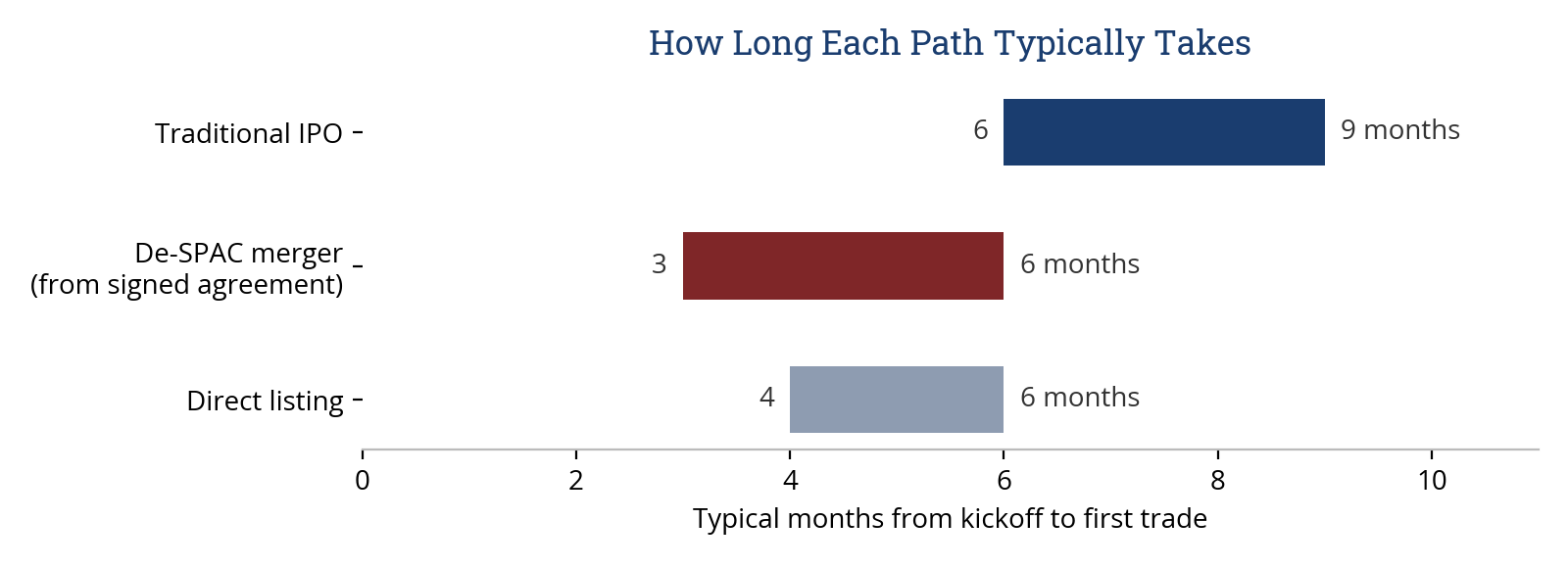
図1. プロセス開始から初値形成までの標準的な所要期間。De-SPACの期間は合併契約締結時点を起点とし、対象企業がPCAOB基準の監査を整備済みであることを前提とする。契約締結前の相手探索・交渉期間は案件により大きく異なる。出所:AUM Advisors。

伝統的IPO SPAC合併(De-SPAC) ダイレクト・リスティング
売却されるもの 新株(引受会社が選定した投資家へ) PIPE投資家への新株。信託資金は残存または償還 なし——既存株式が取引可能になる
価格の決定者 投資家の注文に基づき引受会社と企業 企業とスポンサーの交渉 寄付きオークション
資金調達 あり——主目的 あり——PIPEに加え、残存する信託資金 原則なし
アフターマーケットの支え手 引受会社(グリーンシュー)、その後はリサーチ 株価安定化措置なし。PIPEのロックアップが下支え 存在しない
主な手数料 引受手数料5〜7%+直接費用2〜4% スポンサーのプロモート+助言・私募手数料+SPAC IPO時の繰延手数料 定額の助言報酬+直接費用1〜2%
初値までの標準期間 6〜9カ月 契約締結から3〜6カ月 4〜6カ月
インサイダーのロックアップ 約180日が標準 交渉による。優良案件ではインサイダーとPIPEに12〜18カ月 ないことが多い

表1. 3つの経路の仕組みの比較。出所:AUM Advisors。

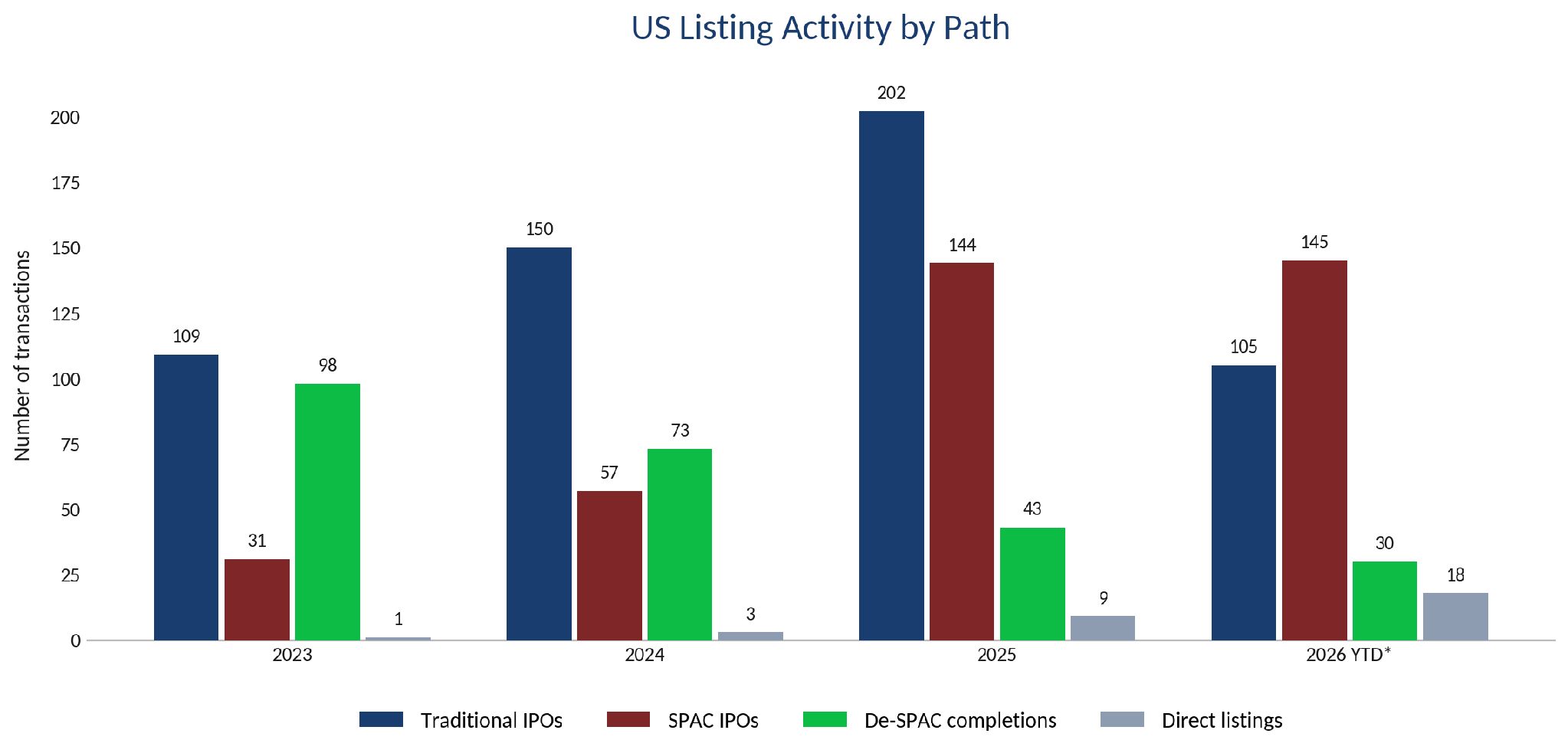
図2. 経路別の米国上場件数(2023年〜2026年*は2026年8月27日まで)。伝統的IPO件数はRenaissance Capital(時価総額5,000万ドル以上、SPAC除く)。SPAC IPOおよびDe-SPAC完了件数はSPAC Insider(2023年のSPAC IPO件数はRenaissance Capital)。ダイレクト・リスティングはJay Ritter教授のTable 13a(2026年8月27日更新)。出所:Renaissance Capital、SPAC Insider、AUM Advisors分析。

各経路がもたらす成果の測定

企業が株式を公開する理由は3つあるのだから、当社は各経路の直近の上場企業群について、株価がどう推移したか、取引市場がどれだけの流動性を獲得したか、そして各群がどれだけのアナリスト・カバレッジを獲得したか——カバレッジは流動性と信認の双方を支える——を測定する。株価の実績は、後続の各経路の章を通じて提示する。
流動性指標についての注記:以下の図表は、2026年9月10日までの直近20営業日平均の売買代金(ドルベース)を用いており、当初想定していた「上場後最初の90営業日」および「直近90営業日」という2つの測定期間は用いていない。したがって図表が示すのは各群の現在の姿であって、その変化の過程ではない。上場後の数カ月間に流動性がどのように変化するかについて、本ガイドはここでは何ら主張しない。
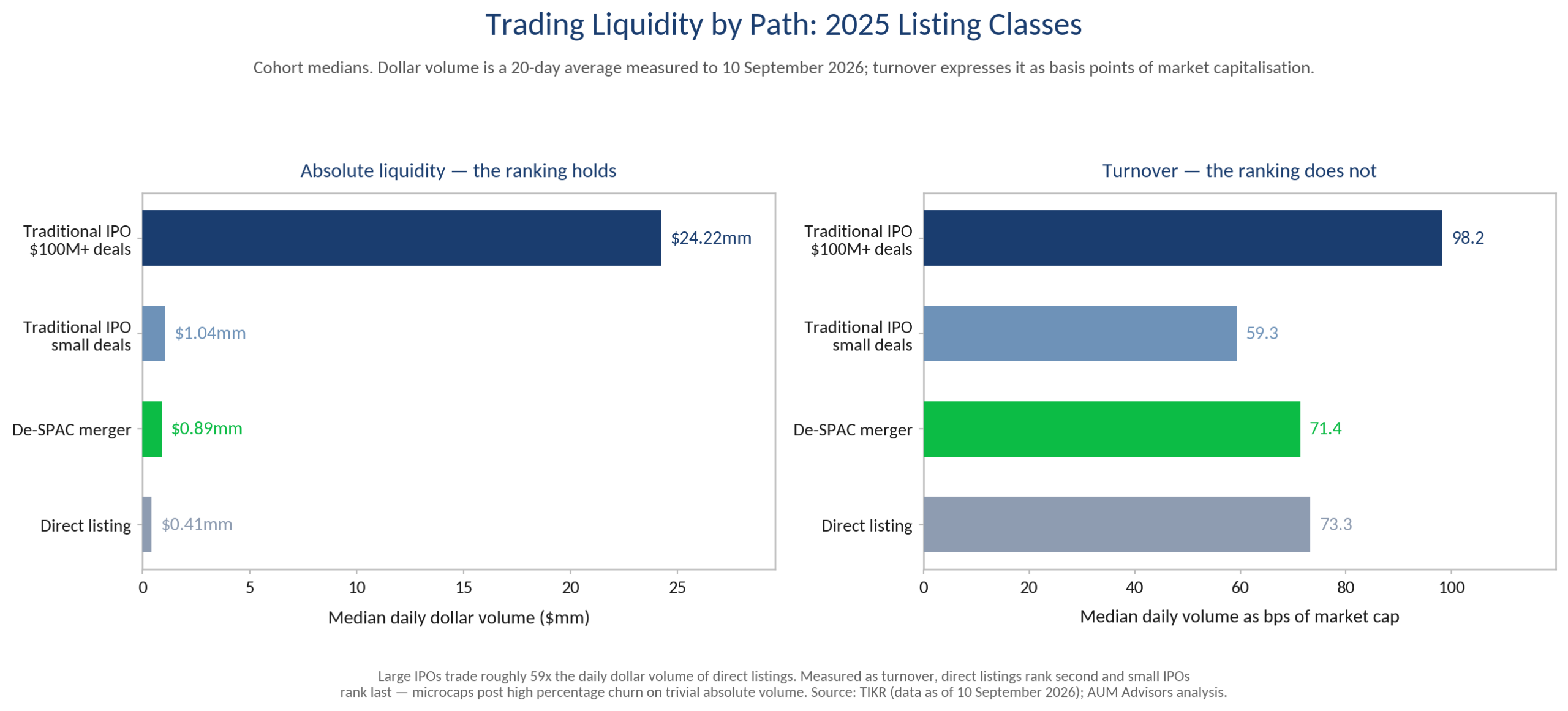
図3. 経路別の取引流動性(2025年上場企業群)。4群の中央値:1億ドル以上の伝統的IPO(n=67)、小型IPO(n=48)、完了済みDe-SPAC(n=37)、ダイレクト・リスティング(n=8)。左パネルは1日当たり売買代金の中央値、右パネルは同じ売買代金を時価総額に対するベーシスポイントで表示。売買代金は2026年9月10日までの20営業日平均。少数の大型銘柄が典型的な姿を覆い隠すことを避けるため、平均値ではなく中央値を用いる。出所:TIKR、AUM Advisors分析。
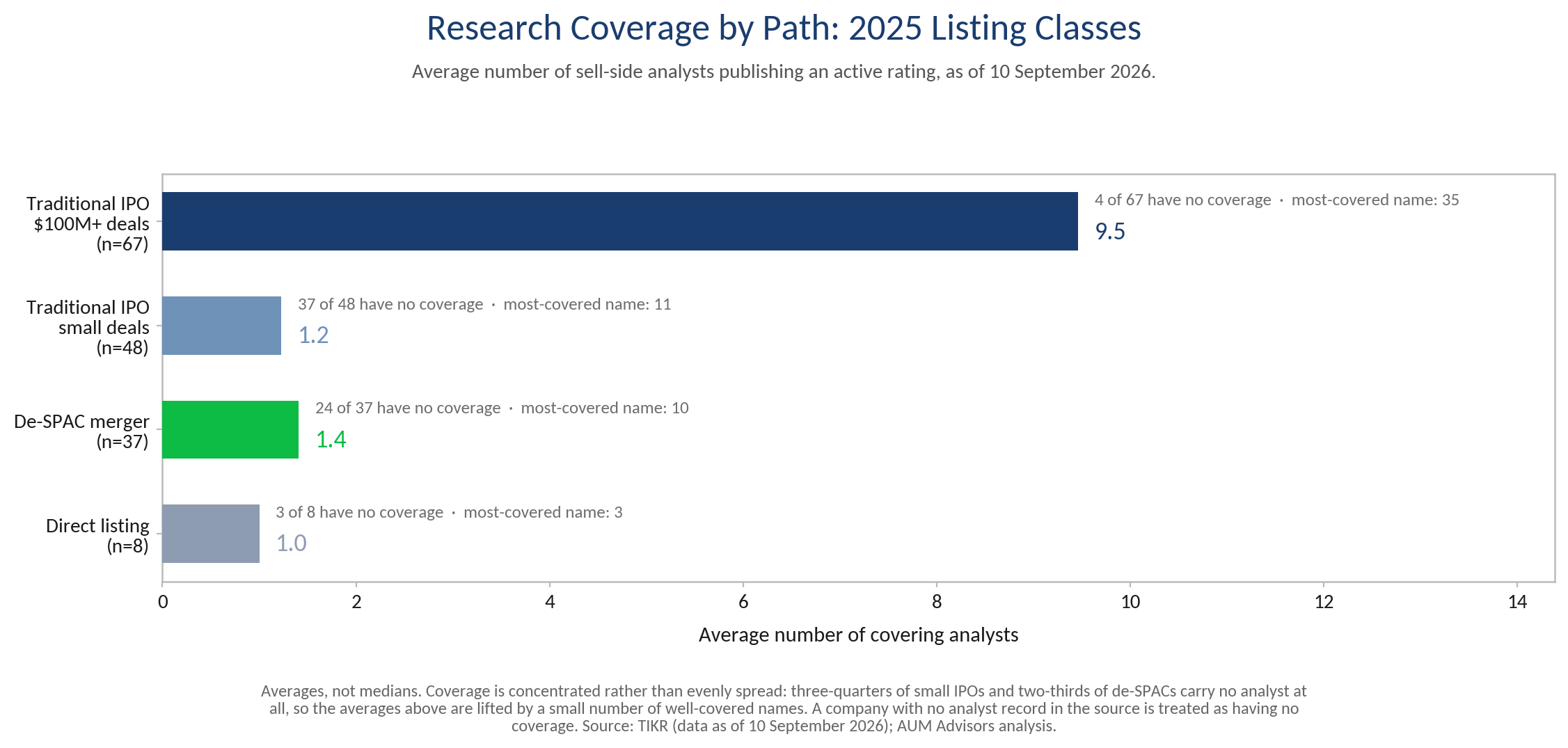
図4. 経路別のアナリスト・カバレッジ(2025年上場企業群)。同じ4群について、レーティングを公表するセルサイド・アナリスト数の平均値を示し、カバレッジが全くない企業の数を各バーに併記。カバレッジは均等に分布するのではなく一部の銘柄に集中しており、平均値は少数の手厚くカバーされた銘柄によって押し上げられている。アナリスト記録のない企業はカバレッジなしとして扱う。カバレッジは機関投資家からの認知度を測る最も明確な代理指標であり、持続的な流動性の先行指標である。出所:TIKR、AUM Advisors分析。

データが示すもの

これらの指標において、大型IPOは大差で首位に立つ。

  • 1日当たり売買代金の中央値は2,422万ドル。小型IPOの104万ドル、De-SPACの89万ドル、ダイレクト・リスティングの41万ドルを大きく上回る。
  • カバレッジ・アナリスト数は平均9.5名。対して小型IPOは1.2名、De-SPACは1.4名、ダイレクト・リスティングは1.0名である。

ただし、絶対額ではなく時価総額に対する売買回転率で測ると、ダイレクト・リスティングは1日当たり73.3ベーシスポイントで第2位となり、De-SPACの71.4、小型IPOの59.3を上回る。この第2位という順位は慎重に読む必要がある。既に崩落した時価総額を分母とする回転率は、流動性ではなく回転売買(チャーン)を映すものである——ドルベースでは、ダイレクト・リスティングの中央値の売買代金はDe-SPACの中央値の半分にも満たない。
なお、小型IPOとDe-SPACはこれらの指標においてほとんど区別がつかない——1日当たり売買代金は104万ドル対89万ドル、カバレッジ・アナリスト数の平均はそれぞれ1.2名対1.4名であり、小型IPOの77%、De-SPACの65%はリサーチ・カバレッジを全く持たない。ここから導かれる要点は次のとおりである。第一に、SPAC合併・小型IPO・ダイレクト・リスティングのいずれも、大半の機関投資家が求める流動性の水準に達するには通常時間を要する。このため、これらの経路を選ぶ企業は上場後の投資家向けマーケティングに一層の時間とエネルギーを投じる必要があり、広く投資可能な銘柄へと「クロスオーバー」するために追加増資(フォローオン)が必要となる場合が多い。第二に、これら3つの経路のいずれで上場する企業も、上場後1年間はリサーチ・カバレッジの獲得に投資する必要がある。リサーチおよび投資銀行の双方との関係を育て、リサーチと資本市場活動を連動させ、場合によっては特定の証券会社とのCMA(キャピタル・マーケッツ・アドバイザリー)契約を検討することも含まれる。

経路I:伝統的IPO

伝統的IPOが標準的な選択肢であり続けるのには理由がある。資金調達・流動性・信認という3つの目的すべてを一度のイベントで実現できる唯一の経路であり、他の経路であれば上場後に(そもそも構築できればの話だが)構築しなければならないインフラを、最初から備えて市場に到着できるからである。

適切に執行されたIPOがもたらすもの

  • 初日からの幅広い機関投資家株主基盤。ブックビルディングの過程で、株式は引受会社が選定した数十の機関投資家——ロングオンリー・ファンド、セクター・スペシャリスト、インデックス関連の買い手——に直接配分される。彼らは経営陣と面談し、事業内容を検討したうえで、保有を選択した投資家である。他の経路では、この株主基盤を上場後1〜2年かけて、面談を一つひとつ積み重ねて獲得しなければならない。
  • 速やかなリサーチ・カバレッジ。引受銀行は通常、IPO後のクワイエット・ピリオド明けにセルサイド・カバレッジを開始する——有力な引受会社による中規模案件であれば、数週間のうちに3〜5名のアナリストが付くことが多い。カバレッジは機関投資家からの認知、バリュエーションの文脈、売買高を牽引する。他の経路で上場した企業は、カバレッジ関係を築くまでの6〜18カ月間、リサーチ空白(リサーチ・デザート)に直面するのが通例である。
  • 上場1年目からの活発な取引。幅広い初期配分、リサーチ、インデックス採用適格性が組み合わさり、相応の規模のIPOでは3経路の中で最も健全な初期取引が実現する。
  • スタート時点でのアフターマーケット支援。グリーンシューにより、引受会社は初期の取引を安定化させる手段とインセンティブの双方を持つ——他の2経路には存在しない緩衝装置である。
  • レピュテーション・プレミアム。公正か否かは別として、「当社はNYSE/Nasdaqで IPOを完了した」という一文は、顧客・取引先・金融機関・買収候補先に対して、他のどのような表現よりも重みを持つ。エンタープライズ営業、規制産業、M&Aプログラムなど、事業戦略が信用力に依存する企業にとって、これは曖昧な便益ではない。受注率や取引条件に表れるのである。

初日株価上昇(ポップ)の理解——コスト、シグナル、戦略

IPOで最も議論される特徴は、初日の株価急騰である。初日リターンの長期平均はおよそ18%(Ritter、1980〜2025年)。2025年は米国IPO全体で19.7%、1億ドル超の案件群では約25%であった。
一つの読み方をすれば、ポップは調達資金に対する暗黙のディスカウントである。企業ではなく、配分を受けた投資家に渡った追加的な価値を意味する。この読み方は正しい。3億ドルの調達で20%のポップが生じれば、およそ6,000万ドルの価格譲歩となり、引受手数料そのものの数倍に相当する。
しかし、ポップにはより繊細な読み方も必要である。
初日の株価上昇は、ある意味で、マーケティングの成功を可視化したものである。需要が供給を大きく上回った結果、投資家は希望したポジションの一部しか配分を受けられず——その後の数週間、市場で買い増しを続けた。この未充足の需要は無駄にはならない。それはアフターマーケットの買い需要となり、追加増資の際の注文となり、最初の数四半期の決算を通じて株価を支える株主基盤となる。
複数回の資金調達を計画する企業は(そして米国市場のシェルフ・レジストレーション、ATMプログラム、転換社債市場を踏まえれば、大半の成長企業はそれを計画すべきである)、2回目・3回目の調達を安価かつ迅速にする投資家基盤を確保するために、最初の調達で価格譲歩を受け入れることに合理性がある。IPOは、可能な限り高い価格で執行する一回きりの売却としてではなく、公開市場との長期的な資金調達関係の最初の取引として理解するのが最も適切である。
したがって実務上の指針は、「ポップを避けよ」ではなく「譲歩が何かを買っていることを確かめよ」である。質の高い機関投資家のブック、速やかなリサーチ・カバレッジ、活発な取引を伴う15〜25%のポップは、有効に使われた譲歩である。見栄えのために「ポップするよう」値付けされ、初日に転売する短期筋に配分されたディールは、何も買っていない。その差は、ほぼすべて引受会社の選定と配分の規律にかかっている——発行体のアドバイザーが真価を発揮すべき領域である。

IPOが適切な選択となる場合

IPOが適するのは、有力な引受会社の関心と注力を引きつけられる企業——現実的には5,000万〜1億ドル以上の募集規模——であり、機関投資家がモデル化できる財務プロファイルを持ち、2週間のマーケティング期間で伝わるストーリーを持つ企業である。
レピュテーション・プレミアムを重視し、複数回の資金調達を計画し、価格決定日の市場リスクを許容できる企業に適している。一方で、規模の閾値に満たない企業、説明に数週間ではなく数カ月を要するストーリー、そして長年待機してきた超大型案件がIPOカレンダーに詰まり、引受会社と投資家の関心を吸い上げている局面には適さない——これは2025〜2026年に実際に起きた現象であり、数年越しの遅延を経て史上有数の大型案件が相次いで市場に到来した。 Read More »

ナスダック、店頭取引SPACの上場基準の改正を提案

この改正では、上場廃止となったSPAC(特別買収目的会社)が事業統合に際し、「シーズニング・ルール(一定期間の上場実績を求める規定)」の適用を受けずに再上場できるようにすることが提案されている。今回の修正は、シーズニング・ルールによる意図しない影響を是正するとともに、新たなSPAC/デSPAC規則が提供する投資家保護の趣旨を尊重する内容となっている。

背景 ― シーズニング・ルールと新SPAC規則

ナスダック、NYSE(ニューヨーク証券取引所)、およびNYSEアメリカンは、いずれも「シーズニング・ルール」と呼ばれる上場基準を設けている。 このシーズニング・ルールは各取引所で文言に多少の違いはあるものの、基本的な内容はほぼ同一であり、以下のような趣旨を持つ(各取引所の規則を意訳)。

上場SPAC以外のシェルカンパニーとの逆合併によって設立された企業は、新規上場申請を行う資格を有し、その後、事業統合後の企業が新規上場申請の提出直前に以下の条件を満たしている場合にのみ、上場資格を得ることができます。

(i) SECまたはその他の監督当局に対し、当該取引に関する必要な情報(統合後企業の監査済み財務諸表を含む、いわゆる「スーパー8-K」)を提出した後、米国の店頭市場、他の国内証券取引所、または規制された外国取引所で少なくとも1年間取引実績を有していること。

(ii) リバース・マージャーの完了以降1年間、SECへの報告書を期限内に提出していること。

(iii) 事業統合完了後の企業の財務諸表について、少なくとも1会計年度分の監査済み年次報告書を提出していること。

(iv) 上場申請基準に適用される株価要件に相当する終値を一定期間維持していること。ただし、承認前直近60取引日のうち少なくとも30取引日間はその株価水準を満たしていなければならない。

このルールには、確定引受方式(firm commitment offering)による株式公開を実施し、純調達額が4,000万ドル以上となる企業に対する例外規定が含まれています。

シーズニング・ルールの目的は、企業が店頭(OTC)シェルとのリバース・マージャーを完了した後、引受証券会社を通じた資金調達やIPOを経ずに、直ちに国内証券取引所への上場(アップリスティング)を申請することを防ぐことにあります。このルールは、合併後の企業が市場での取引実績を有し、財務情報の信頼性が高まり、市場価格の安定性や適切なコーポレート・ガバナンスの履行実績を備えていることを確保することを目的としています。

上場SPACは本ルールの適用除外とされていますが、SPACブームの崩壊およびSPAC/デSPAC取引に関する新たな情報開示義務の強化を受けて、SPACが事業統合を完了するまでの期間が長期化しています。ナスダックの規則では、SPACは原則として36か月以内に事業統合(デSPAC)取引を完了しなければならず、期限内に完了できない場合は上場廃止となります。しかし、新たなSPAC/デSPAC規則の導入以降、多くのSPACが事業統合の完了を待つ間、一時的にOTCマーケットへ移行しており、こうしたSPACが、実質的に大規模なデSPAC取引を行い、新規則を遵守しているにもかかわらず、シーズニング・ルールの適用対象となるのかという疑問が生じています。

新しいSPAC/デSPAC規則は、デSPACに関連する情報開示および手続きを従来のIPOに合わせて整備し、IPOプロセスと同様の投資家保護を提供するものです。これには登録届出書(S-4/F-4)の提出が含まれ、シーズニング・ルールに関連する目的や懸念は事実上解消されます。 私のSPAC/デSPAC規則に関する10回シリーズのブログはこちらをご覧ください: を参照, を参照, を参照, を参照, を参照, を参照, を参照, を参照, を参照, & を参照

企業がシーズニング・ルールの対象となるかどうかの鍵は、リバース・マージャーの定義にあります。ナスダックは現在、リバース・マージャーを「営業会社が、直接的または間接的に、Exchange Actに基づく報告会社であるシェル・カンパニーとリバース・マージャー、株式交換、その他の方法で統合することにより、Exchange Act報告会社となる取引。ただし、IM-5101-2の要件を満たす上場企業による営業会社の取得、またはRule 5110(a)で規定される事業統合はリバース・マージャーに含まれない」と定義しています。IM-5101-2はSPACの上場要件を定めており、Rule 5110(a)は上場シェル以外の企業がリバース・マージャーを完了し支配権が変更される場合、株主承認および新規上場申請を求めています。リバース・マージャーにおけるシェル・カンパニーの定義の詳細については、こちらをご参照ください: を参照.

多くの上場廃止となったSPACは、事業統合(デSPAC)において「リバース・マージャー」の定義に該当しないように、統合後の企業を存続会社とする、三角合併などの構造、またはその他の法的手法を用いてシーズニング・ルールの技術的適用を回避する形で取引を組成してきました。こうしたデSPAC取引に対するルールの実効性の限界を理解したうえで、ナスダックは正当に、形式上の構造を認め、これらの企業が事業統合を完了した際に再上場できることを容認しています。

また、ナスダックの上場規則では、OTCマーケットからアップリスティングする企業は、上場直前30取引日の平均日次取引量(ADV)を最低2,000株以上維持することが求められています(「ADV要件」)。ただし、OTC企業が少なくとも500万ドルの確約引受方式による公募と併せて上場する場合には、ADV要件を満たす必要はありません。SPACは事業統合前の取引が薄く、また事業統合に確約引受方式による公募が含まれることは稀であるため、多くの上場廃止SPACはADV要件を満たすことに課題を抱えてきました。

提案されている新規則

ナスダックは、リバース・マージャーの定義を改正し、登録届出書(S-4/F-4)の効力発生日において、デSPAC取引に関連して上場するSPACを除外することを提案しています。また、ADV要件に関する上場規則についても、登録届出書(S-4/F-4)の効力発生日において、デSPAC取引に関連して上場する企業を除外する改正が提案されています。これらの変更により、OTC市場で取引されるSPACのデSPAC取引は、上場SPACによるデSPAC取引と同等に扱われることになります。

著者

ローラ・アンソニー弁護士

設立パートナー

アンソニー、リンダー&カコマノリス

企業法務および証券法務事務所

LAnthony@ALClaw.com

証券弁護士ローラ・アンソニー氏とその経験豊富な法律チームは、中小規模の非公開企業、上場企業、そして上場予定の非公開企業に対して継続的な企業顧問サービスを提供しています。ナスダック、NYSEアメリカン、または店頭市場(例えばOTCQBやOTCQX)で上場を目指す企業も対象です。20年以上にわたり、Anthony, Linder & Cacomanolis, PLLC(ALC)は、迅速でパーソナライズされた最先端の法的サービスをクライアントに提供してきました。当事務所の評判と人脈は、投資銀行、証券会社、機関投資家、その他の戦略的提携先への紹介など、クライアントにとって非常に貴重なリソースとなっています。当事務所の専門分野には、1933年証券法の募集・販売および登録要件の遵守(レギュレーションDおよびレギュレーションSに基づく私募取引、PIPE取引、証券トークン・オファリング、イニシャル・コイン・オファリングを含む)が含まれますが、これに限定されません。規制A/A+オファリング、S-1、S-3、S-8フォームの登録申請、S-4フォームによる合併登録、1934年証券取引法の遵守(フォーム10による登録、フォーム10-Q、10-K、8-Kおよび14C情報・14A委任状報告書)、あらゆる形態の株式公開取引、合併・買収(リバースマージャーおよびフォワードマージャーを含む)、ナスダックやNYSEアメリカンを含む証券取引所のコーポレートガバナンス要件への申請および遵守、一般企業取引、一般契約および事業取引が含まれます。アンソニー氏と当事務所は、合併・買収取引において、買収対象企業と買収企業の双方を代理し、合併契約、株式交換契約、株式購入契約、資産購入契約、組織再編契約などの取引文書を作成します。ALC法務チームは、公開企業が連邦および州の証券法やSROs要件に準拠することを支援しており、15c2-11申請、社名変更、リバース・フォワードスプリット、本拠地変更などにも対応しています。アンソニー氏はまた、中堅・中小企業向けの業界ニュースのトップ情報源であるSecuritiesLawBlog.comの著者であり、企業財務に特化したポッドキャスト『LawCast.com: Corporate Finance in Focus』のプロデューサー兼ホストでもあります。当事務所は、ニューヨーク、ロサンゼルス、マイアミ、ボカラトン、ウェストパームビーチ、アトランタ、フェニックス、スコッツデール、シャーロット、シンシナティ、クリーブランド、ワシントンD.C.、デンバー、タンパ、デトロイト、ダラスなど、多くの主要都市でクライアントを代理しています。

アンソニー氏は、Crowdfunding Professional Association(CfPA)、パームビーチ郡弁護士会、フロリダ州弁護士会、アメリカ弁護士会(ABA)および連邦証券規制やプライベート・エクイティ・ベンチャーキャピタルに関するABA委員会など、さまざまな専門団体のメンバーです。パームビーチ郡およびマーティン郡のアメリカ赤十字社、スーザン・コーメン財団、オポチュニティ社(Opportunity, Inc.)、ニュー・ホープ・チャリティーズ、フォー・アーツ協会(Society of the Four Arts)、ノートン美術館、パームビーチ郡動物園協会、クラヴィス・パフォーミング・アーツ・センターなど、複数の地域社会慈善団体を支援しています。

アンソニー氏はフロリダ州立大学ロースクールを優秀な成績で卒業しており、1993年から弁護士として活動しています。

Anthony, Linder & Cacomanolis, PLLC にお問い合わせください。技術的な内容に関するご質問もいつでも歓迎いたします。

Anthony, Linder & Cacomanolis, PLLC を Facebook、LinkedIn、YouTube、Pinterest、Twitter でフォローしてください。

Anthony, Linder & Cacomanolis, PLLCは、本情報を教育目的の一般情報として提供しています。本情報は一般的な内容であり、法的助言を構成するものではありません。さらに、本情報の利用や送受信は、当事務所との弁護士–依頼者関係を成立させるものではありません。したがって、本情報を通じて当事務所と行ういかなる通信も、特権または機密として扱われることはありません。

© Anthony, Linder & Cacomanolis, PLLC


  Read More »

NASDAQ Proposes To Modify Listing Standards For OTC Traded SPACS

On August 22, 2025, Nasdaq proposed a modification to the listing rules to allow delisted SPAC’s to relist in conjunction with a business combination without being subject to the seasoning rule.  The amendment will correct a potential unintended consequence of the seasoning rule while giving credence to the investor protections offered by the new SPAC/de-SPAC rules.

Background – Seasoning Rule and New SPAC Rules

Nasdaq, NYSE and NYSE American, all have a listing standard known as the seasoning rule. The seasoning rule is substantially the same for each exchange and provides that (paraphrasing the rule which is written slightly differently for each exchange):

A company that is formed by a reverse merger with a shell company, other than a listed SPAC, will only be eligible to submit an application for initial listing and thereafter qualify to be listed if immediately preceding the filing of the initial listing application the post business combination company:

(i) Has traded Read More »

SEC Publishes New CD&I On Compensation Clawbacks And De-SPAC C-Registrants

On April 11, 2025, the SEC published several updates to its compliance and disclosure interpretations (“CD&I”) related to compensation clawbacks and co-registrants in de-SPAC transactions.

De-SPAC Transactions

Under the new SPAC rules, a target company, or companies, are included as co-registrants on the S-4 (or other Securities Act registration statement) in association with the de-SPAC.  Under Exchange Act rules, upon effectiveness of the S-4, each of the target co-registrants become separately subject to the Exchange Act reporting requirements.  New C&DI 253.03 confirms that the SEC will not object if each target co-registrant files a Form 15, as long as they are wholly owned by the combined company and the combined company remains current in its Exchange Act reporting requirements.

For a review of the new de-SPAC rules see here – Part 1 – HERE; Part 2 – HERE; Part 3 – HERE; Part 4 – HERE; Part 5 – HERE; Read More »

SEC Adopts Final Rules On SPACs, Shell Companies And The Use Of Projections – Part 10

On January 24, 2024, the SEC adopted final rules enhancing disclosure obligations for SPAC IPOs and subsequent de-SPAC business combination transactions.  The rules are designed to more closely align the required disclosures and legal liabilities that may be incurred in de-SPAC transactions with those in traditional IPOs.  The new rules spread beyond SPACs to shell companies and blank check companies in general.  The compliance date for the new rules is July 1, 2025.

In the first blog in this series, I provided background on and a summary of the new rules – see HERE.  The second blog began a granular discussion of the 581-page rule release starting with partial coverage of new Subpart 1600 to Regulation S-K related to disclosures in SPAC IPO’s and de-SPAC transactions – see HERE.  The third blog in the series continued the summary of Subpart 1600 and in particular the new dilution disclosure requirements – see HERE.  Part 4 continued a Read More »

SEC Adopts Final Rules On SPACs, Shell Companies And The Use Of Projections – Part 9

On January 24, 2024, the SEC adopted final rules enhancing disclosure obligations for SPAC IPOs and subsequent de-SPAC business combination transactions.  The rules are designed to more closely align the required disclosures and legal liabilities that may be incurred in de-SPAC transactions with those in traditional IPOs.  The new rules spread beyond SPACs to shell companies and blank check companies in general.  The compliance date for the new rules is July 1, 2025.

In the first blog in this series, I provided background on and a summary of the new rules – see HERE.  The second blog began a granular discussion of the 581-page rule release starting with partial coverage of new Subpart 1600 to Regulation S-K related to disclosures in SPAC IPO’s and de-SPAC transactions – see HERE.  The third blog in the series continued the summary of Subpart 1600 and in particular the new dilution disclosure requirements – see HERE.  Part 4 continued a review of Read More »

SEC Adopts Final Rules On SPACS, Shell Companies And The Use Of Projections – Part 8

On January 24, 2024, the SEC adopted final rules enhancing disclosure obligations for SPAC IPOs and subsequent de-SPAC business combination transactions.  The rules are designed to more closely align the required disclosures and legal liabilities that may be incurred in de-SPAC transactions with those in traditional IPOs.  The new rules spread beyond SPACs to shell companies and blank check companies in general.  The compliance date for the new rules is July 1, 2025.

In the first blog in this series, I provided background on and a summary of the new rules – see HERE.  The second blog began a granular discussion of the 581-page rule release starting with partial coverage of new Subpart 1600 to Regulation S-K related to disclosures in SPAC IPO’s and de-SPAC transactions – see HERE.  The third blog in the series continued the summary of Subpart 1600 and in particular the new dilution disclosure requirements – see HERE.  Part 4 continued a Read More »

SEC Adopts Final Rules On SPACS, Shell Companies And The Use Of Projections – Part 7

On January 24, 2024, the SEC adopted final rules enhancing disclosure obligations for SPAC IPOs and subsequent de-SPAC business combination transactions.  The rules are designed to more closely align the required disclosures and legal liabilities that may be incurred in de-SPAC transactions with those in traditional IPOs.  The new rules spread beyond SPACs to shell companies and blank check companies in general.  The compliance date for the new rules is July 1, 2025.

In the first blog in this series, I provided background on and a summary of the new rules – see HERE.  The second blog began a granular discussion of the 581-page rule release starting with partial coverage of new Subpart 1600 to Regulation S-K related to disclosures in SPAC IPO’s and de-SPAC transactions – see HERE.  The third blog in the series continued the summary of Subpart 1600 and in particular the new dilution disclosure requirements – see HERE.  Part 4 continued a review of Read More »

SEC Adopts Final Rules On SPACS, Shell Companies And The Use Of Projections – Part 6

On January 24, 2024, the SEC adopted final rules enhancing disclosure obligations for SPAC IPOs and subsequent de-SPAC business combination transactions.  The rules are designed to more closely align the required disclosures and legal liabilities that may be incurred in de-SPAC transactions with those in traditional IPOs.  The new rules spread beyond SPACs to shell companies and blank check companies in general.  The compliance date for the new rules is July 1, 2025.

In the first blog in this series, I provided background on and a summary of the new rules – see HERE.  The second blog began a granular discussion of the 581-page rule release starting with partial coverage of new Subpart 1600 to Regulation S-K related to disclosures in SPAC IPO’s and de-SPAC transactions – see HERE.  The third blog in the series continued the summary of Subpart 1600 and in particular the new dilution disclosure requirements – see HERE.  Part 4 continued a review Read More »

SEC Adopts Final Rules On SPACS, Shell Companies And The Use Of Projections – Part 5

On January 24, 2024, the SEC adopted final rules enhancing disclosure obligations for SPAC IPOs and subsequent de-SPAC business combination transactions.  The rules are designed to more closely align the required disclosures and legal liabilities that may be incurred in de-SPAC transactions with those in traditional IPOs.  The new rules spread beyond SPACs to shell companies and blank check companies in general.  The compliance date for the new rules is July 1, 2025.

In the first blog in this series, I provided background on and a summary of the new rules – see HERE.  Last week’s blog began a granular discussion of the 581-page rule release starting with partial coverage of new Subpart 1600 to Regulation S-K related to disclosures in SPAC IPO’s and de-SPAC transactions – see HERE.  The third blog in the series continued the summary of Subpart 1600 and in particular the new dilution disclosure requirements – see HERE.  Part 4 continued a Read More »

SEC Adopts Final Rules On SPACS, Shell Companies And The Use Of Projections – Part 4

On January 24, 2024, the SEC adopted final rules enhancing disclosure obligations for SPAC IPOs and subsequent de-SPAC business combination transactions.  The rules are designed to more closely align the required disclosures and legal liabilities that may be incurred in de-SPAC transactions with those in traditional IPOs.  The new rules spread beyond SPACs to shell companies and blank check companies in general.  The compliance date for the new rules is July 1, 2025.

In the first blog in this series, I provided background on and a summary of the new rules – see HERE.  Last week’s blog began a granular discussion of the 581-page rule release starting with partial coverage of new Subpart 1600 to Regulation S-K related to disclosures in SPAC IPO’s and de-SPAC transactions – see HERE.  The third blog in the series continued the summary of Subpart 1600 and in particular the new dilution disclosure requirements – see HERE.  This week’s blog will Read More »

SEC Adopts Final Rules On SPACS, Shell Companies And The Use Of Projections – Part 3

On January 24, 2024, the SEC adopted final rules enhancing disclosure obligations for SPAC IPOs and subsequent de-SPAC business combination transactions.  The rules are designed to more closely align the required disclosures and legal liabilities that may be incurred in de-SPAC transactions with those in traditional IPOs.  The new rules spread beyond SPACs to shell companies and blank check companies in general.  The compliance date for the new rules is July 1, 2025.

In the first blog in this series, I provided background on and a summary of the new rules – see HERE.  Last week’s blog began a granular discussion of the 581-page rule release starting with partial coverage of new Subpart 1600 to Regulation S-K related to disclosures in SPAC IPO’s and de-SPAC transactions – see HERE.  This week’s blog will continue a review of new Subpart 1600 to Regulation S-K.

New Subpart 1600 of Regulation S-K

The SEC has adopted new Subpart 1600 to Read More »

SEC Adopts Final Rules On SPACS, Shell Companies And The Use Of Projections – Part 2

On January 24, 2024, the SEC adopted final rules enhancing disclosure obligations for SPAC IPOs and subsequent de-SPAC business combination transactions.  The rules are designed to more closely align the required disclosures and legal liabilities that may be incurred in de-SPAC transactions with those in traditional IPOs.  The new rules spread beyond SPACs to shell companies and blank check companies in general.

In last week’s blog, I provided background on and a summary of the new rules – see HERE.  This week’s blog begins a granular discussion of the 581-page rule release and its vast implications to not only the SPAC market, but shell company reverse mergers in general.  This week in particular, I will begin coverage of new Subpart 1600 to Regulation S-K related to disclosures in SPAC IPO’s and de-SPAC transactions.

New Subpart 1600 of Regulation S-K

The SEC has adopted new Subpart 1600 to Regulation S-K to: (i) set forth disclosure obligations for Read More »

SEC Adopts Final Rules On SPACS, Shell Companies And The Use Of Projections – Part 1

On January 24, 2024, the SEC adopted final rules enhancing disclosure obligations for SPAC IPOs and subsequent de-SPAC business combination transactions.  The rules are designed to more closely align the required disclosures and legal liabilities that may be incurred in de-SPAC transactions with those in traditional IPOs.  The new rules spread beyond SPACs to shell companies and blank check companies in general.

The SEC is specifically requiring enhanced disclosures with respect to compensation paid to sponsors, conflicts of interest, dilution, and the determination, if any, of the board of directors (or similar governing body) of a SPAC regarding whether a de-SPAC transaction is advisable and in the best interests of the SPAC and its shareholders.  The SEC has also adopted rules that deem any business combination transaction involving a reporting shell company, including a SPAC, to involve a sale of securities to the reporting shell company’s shareholders, and has amended several financial statement requirements applicable to transactions involving Read More »

SEC Chair Gary Gensler’s Annual Congressional Testimony

On September 12, 2023, Gary Gensler gave his annual testimony to the United States Senate Committee on Banking, Housing and Urban Affairs and then on September 27th to the United States House of Representatives Committee on Financial Services (for a review of last year’s testimony see HERE).  Both appearances included the same prepared remarks followed by robust Q&A from the lawmakers.

This year Chair Gensler’s prepared remarks focused on: (i) rule amendments and updates; (ii) improving efficiency in equity markets; (iii) disclosure matters and related enforcement including related to cryptocurrency; and (iv) general updates on the SEC and capital markets.

Prepared Remarks

We shouldn’t expect the busy SEC rule making agenda to slow down any time soon.  Chair Gensler prioritizes updating rules for technology, business and market changes.  Although Gensler’s speech focuses on rule changes to make the markets more efficient and resilient and lower costs, the reality is that not all rule changes will accomplish Read More »

SEC Spring 2023 Regulatory Agenda

On June 13, 2023, the SEC published its semiannual Spring 2023 regulatory agenda (“Agenda”) and plans for rulemaking.  The Agenda is published twice a year, and for several years I have blogged about each publication.  Although items on the Agenda can move from one category to the next, be dropped off altogether, or new items pop up in any of the categories (including the final rule stage), the Agenda provides valuable insight into the SEC’s plans and the influence that comments can make on the rulemaking process.

The Agenda is broken down by (i) “Pre-rule Stage”; (ii) Proposed Rule Stage; (iii) Final Rule Stage; and (iv) Long-term Actions.  The Proposed and Final Rule Stages are intended to be completed within the next 12 months and Long-term Actions are anything beyond that.  The number of items to be completed in a 12-month time frame is 55, which is in-line with the average items under Gary Gensler’s regime (and much higher than Read More »

SPAC Director And Sponsor Fiduciary Obligations

A year following the Delaware Chancery Court’s decision in Multiplan Corp. Stockholders Litigation (f/k/a Churchill Capital Corp III), the court again issued an opinion supporting a breach of fiduciary duty cause of action against SPAC directors and sponsors and confirming that a de-SPAC transaction should be reviewed using the “entire fairness” standard.  In the January 2023 case of Delman v. Gigacquisitions3, LLC, et al. the Delaware Court denied a motion to dismiss by SPAC sponsors and directors, upholding their potential liability.  Interestingly, the Delman motion was in front of the same vice-chancellor as was Multiplan.  My blog on the Multiplan Corp. Stockholders Litigation (f/k/a Churchill Capital Corp III) case and its ramifications can be read HERE.

In addition to confirming the inherent conflict of interest of SPAC sponsors and directors, the cases will undoubtedly cause practitioners and market participants to implement new policies and procedures related to proxy statement disclosures, diligence, board discussions, financial valuations, capital raising Read More »

Class Voting in Delaware – The Saga Continues

Just a few weeks ago, I wrote about the Garfield v. Boxed, Inc. case in Delaware questioning whether Class A and Class B common stock in a SPAC structure were different series of a same class or different classes of stock requiring separate class voting in certain circumstances (see HERE).  The Delaware Chancery court in Garfield v. Boxed, found that in that particular case, the Class A and Class B were separate classes requiring a separate class vote to increase the total outstanding common stock as required by the Delaware General Corporate Law (DGCL) Section 242(b)(2).

Following the Garfield decision, there has been a run on the Chancery Court by post-business-combination SPACs seeking to ratify shareholder approvals obtained during the de-SPAC process, in reliance on DGCL Section 205.  Although the wording has varied, in essence each of the companies have asked the Chancery court to (i) validate and declare effective the company’s current certificate of incorporation Read More »

Class Voting In Delaware And The Impact On SPACs

In December 2022, the Delaware Chancery Court entered a ruling sending the SPAC world spiraling, for what seems like the 10th time in the last couple of years.  As is always the case in a SPAC (or at least 99% of the time), common stock is broken into two series, Class A and Class B.  The Class A common stock is issued to the public shareholders in the underwritten initial public offering and the Class B common stock is issued to the sponsor.  Upon closing a business combination transaction, the sponsor Class B common stock automatically converts into Class A common stock, leaving one Class of common stock.  Also, in the majority of SPAC transactions, the shareholder approval for the business combination transaction involves other changes to the charter documents for the SPAC, including a name change, and changes in authorized capital stock, etc.  The term “charter” in this blog refers to the certificate of incorporation and any amendments Read More »

2022 Annual Report Of The Office Of The Advocate For Small Business Capital Formation

The Office of the Advocate for Small Business Capital Formation (“Office”) has published its Annual Report for fiscal year 2022 (“Report”).  The Report is delivered to the Committee on Banking, Housing, and Urban Affairs of the U.S. Senate and the Committee on Financial Services of the U.S. House of Representatives directly by the Office, without review or input from the SEC at large.

Background

The SEC’s Office of the Advocate for Small Business Capital Formation launched in January 2019 after being created by Congress pursuant to the Small Business Advocate Act of 2016 (see HERE).  The mission of the Office is to advocate for pragmatic solutions to accessing capital markets and business growth.

The Office has the following functions: (i) assist small businesses (privately held or public with a market cap of less than $250 million) and their investors in resolving problems with the SEC or self-regulatory organizations; (ii) identify and propose regulatory changes that would benefit small businesses Read More »

SEC Proposes New Rules For SPACs – Part 6

On March 30, 2022, the SEC proposed rules related to SPAC and de-SPAC transactions including significantly enhanced disclosure obligations including related to financial projections, making a target company a co-registrant when a SPAC files an S-4 or F-4 registration statement associated with a business combination, and aligning de-SPAC transactions with initial public offering rules.  In addition, the SEC has also proposed rules that would deem any business combination transaction involving a reporting shell company, including but not limited to a SPAC, to involve a sale of securities to the reporting shell company’s shareholders.  The new rules would amend a number of financial statement requirements applicable to transactions involving shell companies.

In addition, the SEC has proposed a new safe harbor under the Investment Company Act of 1940 (‘40 Act’) that would provide that a SPAC that satisfies the conditions of the proposed rule would not be an investment company and therefore would not be subject to regulation under the Read More »

SEC Proposes New Rules For SPACs – Part 5

On March 30, 2022, the SEC proposed rules related to SPAC and de-SPAC transactions including significantly enhanced disclosure obligations, expanding the scope of deemed public offerings in these transactions, making a target company a co-registrant when a SPAC files an S-4 or F-4 registration statement associated with a business combination, and aligning de-SPAC transactions with initial public offering rules.  In addition, the SEC has also proposed rules that would deem any business combination transaction involving a reporting shell company, including but not limited to a SPAC, to involve a sale of securities to the reporting shell company’s shareholders.  The new rules would amend a number of financial statement requirements applicable to transactions involving shell companies.

In addition to proposing new rules for SPAC and de-SPAC transactions, the SEC is proposing new Securities Act Rule 145a that would deem all business combinations with an Exchange Act reporting shell to involve the sale of securities to the reporting shell company’s Read More »

SEC Proposes New Rules for SPACs- Part 4

On March 30, 2022, the SEC proposed rules enhancing disclosure requirements associated with SPAC initial public offerings (IPOs) and de-SPAC merger transactions; requiring that a private operating company be a co-registrant when a SPAC files an S-4 or F-4 registration statement associated with a business combination; requiring a re-determination of smaller reporting company status within four days following the consummation of a de-SPAC transaction; amending the definition of a “blank check company” to make the liability safe harbor in the Private Securities Litigation Reform Act of 1995 for forward-looking statement such as projections, unavailable in filings by SPACs and other blank check companies; and deeming underwriters in a SPAC IPO to be underwriters in a de-SPAC transaction when certain conditions are met.

The proposed rules would require specialized disclosure with respect to compensation paid to sponsors, conflicts of interest, dilution and the fairness of business combination transactions.  Further disclosures will also be required in connection with the use of projections.  Read More »

SEC Proposes New Rules for SPACs- Part 3

On March 30, 2022, the SEC proposed rules enhancing disclosure requirements associated with SPAC initial public offerings (IPOs) and de-SPAC merger transactions; requiring that a private operating company be a co-registrant when a SPAC files an S-4 or F-4 registration statement associated with a business combination; requiring a re-determination of smaller reporting company status within four days following the consummation of a de-SPAC transaction; amending the definition of a “blank check company” to make the liability safe harbor in the Private Securities Litigation Reform Act of 1995 for forward-looking statement such as projections, unavailable in filings by SPACs and other blank check companies; and deeming underwriters in a SPAC IPO to be underwriters in a de-SPAC transaction when certain conditions are met.

The proposed rules would require specialized disclosure with respect to compensation paid to sponsors, conflicts of interest, dilution and the fairness of business combination transactions.  Further disclosures will also be required in connection with the use of Read More »

SEC Proposes New SPAC Rules – Part 2

On March 30, 2022, the SEC proposed rules enhancing disclosure requirements associated with SPAC initial public offerings (IPOs) and de-SPAC merger transactions; requiring that a private operating company be a co-registrant when a SPAC files an S-4 or F-4 registration statement associated with a business combination; requiring a re-determination of smaller reporting company status within four days following the consummation of a de-SPAC transaction; amending the definition of a “blank check company” to make the liability safe harbor in the Private Securities Litigation Reform Act of 1995 for forward-looking statement such as projections, unavailable in filings by SPACs and other blank check companies; and deeming underwriters in a SPAC IPO to be underwriters in a de-SPAC transaction when certain conditions are met.

The proposed rules would require specialized disclosure with respect to compensation paid to sponsors, conflicts of interest, dilution and the fairness of business combination transactions.  Further disclosures will also be required in connection with the use of projections.  Read More »

SEC Proposes New SPAC Rules – Part 1

As I wrote about last week, the SEC has had a very busy rule-making few weeks.  In addition to issuing six new compliance and disclosure interpretations (C&DI) for merger and acquisition transactions, most of which directly impact SPAC business organization transactions, it also proposed new rules on SPACs and all shell companies in a 372-page release. The new C&DI were the topic of last week’s blog (HERE) and in a multi-part blog series, I am delving into the proposed new SPAC rules.

On March 30, 2022, the SEC proposed rules enhancing disclosure requirements associated with SPAC initial public offerings (IPOs) and de-SPAC merger transactions; requiring that a private operating company be a co-registrant when a SPAC files an S-4 or F-4 registration statement associated with a business combination; requiring a re-determination of smaller reporting company status within four days following the consummation of a de-SPAC transaction; amending the definition of a “blank check company” to make the Read More »

Categories

Contact Author

Laura Anthony Esq

Have a Question for Laura Anthony?